
- Official title
- Declaration Under Uniform Child Custody Jurisdiction and Enforcement Act (UCCJEA)
- Issued by
- Judicial Council of California
- Revision
- Rev. January 1, 2025
- Use
- Mandatory
- Official PDF
- FL-105/GC-120 on www.courts.ca.gov
The family-law petition is nearly ready, but the children have lived at more than one address and another court may already have entered an order. FL-105 is filed with FL-100, or with the joint petition FL-700, whenever the parties have minor children. It gives the court information about the children before custody or visitation orders.
The same two-page form has a second number, GC-120. It serves probate guardianship cases filed in probate court as well as family-law cases. The current edition took effect January 1, 2025 and is adopted for mandatory use.
This page explains the statewide form and the information printed on it. It is general information, not legal advice about jurisdiction, confidentiality, or what to disclose in a particular case.
What does FL-105 ask about each child?
Item 2 starts with the number of minor children in the proceeding. For each child, the form asks for a full name, date of birth, and city and state of birth. Additional children can be listed on an attachment labeled “FL-105, Attachment 2, Additional Children.”
Item 3 requests the current address and residence history for the past five years. The requested details include the dates of residence, city and state, the person with whom the child lived, that person's complete current address, and the relationship. If every listed child lived together, one history covers them. If they did not, the form directs the filer to attach FL-105(A)/GC-120(A) for each other child's history.
The form has a narrow confidential-address option. If the child's current address is confidential under Family Code section 3429, the filer checks the confidential box and provides only the state of residence.
What other cases and custody claims must be identified?
Item 4 asks whether the declarant knows about or participated in another court case or custody or visitation proceeding concerning a child in the case, in California or elsewhere. If the answer is yes, the form requests the proceeding, case number, court and location, order or judgment date, each child's name, the declarant's connection, and case status. It also says to attach a copy of the orders if one is available.
Item 5 records domestic violence restraining or protective orders now in effect. Item 6 asks about any nonparty who has physical custody of a child or claims custody or visitation rights. For each person, the form requests a name and address, the claimed right or physical-custody status, and the name of each child involved.
Why does the court need this information?
The form is a declaration under the Uniform Child Custody Jurisdiction and Enforcement Act, cited as Family Code section 3400 et seq. Family Code section 3421 supplies the home-state rule for initial child custody jurisdiction. The five-year residence history, other proceedings, existing orders, and other custody claims give the court the child-specific information requested by the declaration before it makes custody or visitation orders.
The dual form number reflects its second setting. In a probate guardianship, it is GC-120, and its footer cites Probate Code sections 1510(f) and 1512. In either setting, the signature declares under penalty of perjury under California law that the information is true and correct.
What should be checked before the declaration is signed?
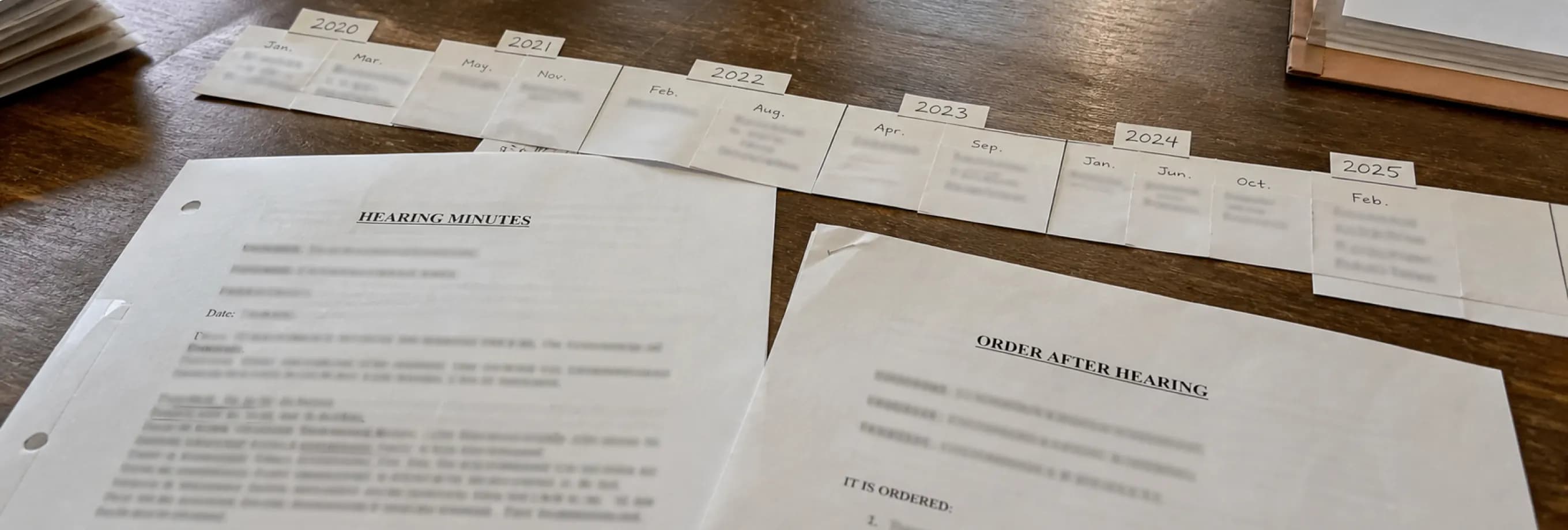
The address timeline can be checked month by month against the five-year period printed on the form. The case section calls for courts in California or elsewhere, and the order section asks for copies when they are available. The form also asks for the number of attached pages.
After signing, the declarant has a continuing duty to inform the court if they obtain information about a custody proceeding in a California court or any other court concerning a child in the case. Chinese Simplified, Korean, Spanish, and Vietnamese translations are available for reference; the English form is filed.
For the petition still on the table, a limited-scope review can stay focused on the residence history, the other-case entries, and the attachments before filing. The court directory leads to county courts, and AttorneyIndex lists family law attorneys in Los Angeles without selecting or recommending one.
Common questions
- What is California form FL-105/GC-120?
- It is the mandatory UCCJEA declaration that gives the court information about children before custody or visitation orders. In a probate guardianship case, the same form is called GC-120.
- When is FL-105 filed?
- FL-105 is filed together with FL-100 or FL-700 whenever the parties have minor children.
- How much residence history does FL-105 request?
- The form requests each child's current address and residence history for the past five years, including dates, places, the person the child lived with, that person's current address, and the relationship.
- Can an address be kept confidential on FL-105?
- The form says that if the current address is confidential under Family Code section 3429, the filer checks the confidential box and provides only the state of residence.
- Is FL-105 available in other languages?
- California Courts provides Chinese Simplified, Korean, Spanish, and Vietnamese translations for reference. The English form is filed with the court.
Sources
Checked on September 22, 2026. Where this page and a court’s own published material disagree, the court is authoritative.
- Judicial Council of California — Form FL-105/GC-120 (opens in a new tab)
- California Courts Self-Help — Form FL-105 information (opens in a new tab)
- Family Code section 3400 — UCCJEA citation (opens in a new tab)
- Family Code section 3421 — initial child custody jurisdiction (opens in a new tab)
- Family Code section 3429 — identifying information (opens in a new tab)
- Probate Code section 1510 — guardianship petition (opens in a new tab)
- Probate Code section 1512 (opens in a new tab)