
A California divorce is a sequence with a fixed order. You cannot finish step six before step three, the clock does not start when you file, and two of the steps that feel like formalities are the ones that most often send a judgment package back. This page lays out the whole process, with the form numbers and the points where cases stall.
This is a description of the procedure, not legal advice about any case. California is a no-fault state: the ground is irreconcilable differences, and no one has to prove wrongdoing.
Before anything: residency
To file for dissolution in California, one spouse must have lived in the state for six months and in the filing county for three months. Legal separation has no such requirement, which is why people who have just moved sometimes file for separation first and amend later.
Step 1 — Open the case
Forms: FL-100 (Petition), FL-110 (Summons), and FL-105 (UCCJEA declaration) if there are minor children.
The petition names the parties, the date of marriage and separation, the children, and the orders requested. It is filed with the superior court in the county, which assigns a case number.
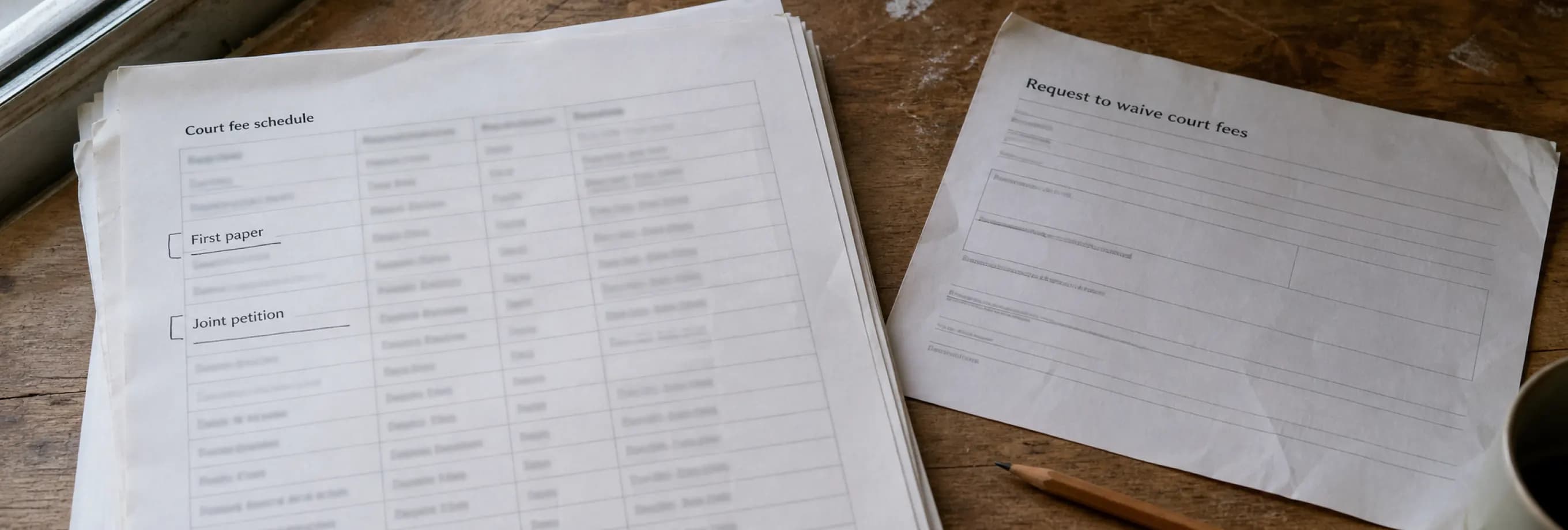
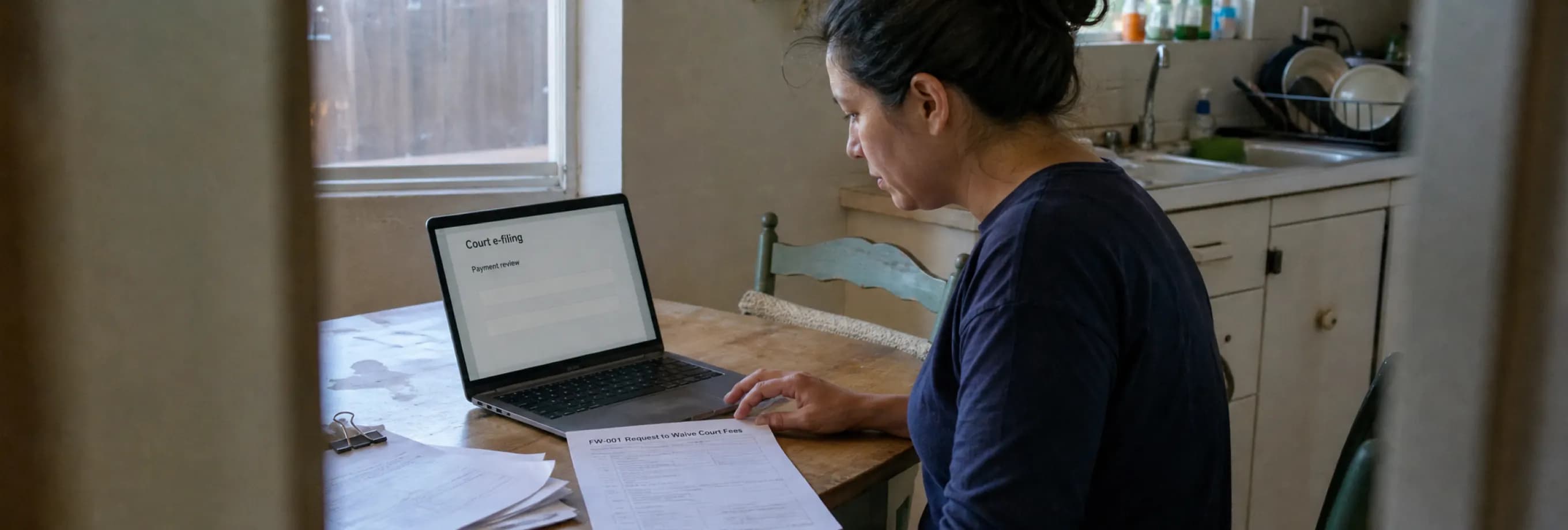
Fee: roughly $435, plus any county surcharge. FW-001 requests a waiver, decided on income or inability to meet basic needs.
Since January 1, 2026 there is a second door, set out in full in California's joint divorce petition. Spouses who agree can open the case together on FL-700 (Joint Petition) with FL-710 (Summons—Joint Petition), plus FL-105 where there are minor children. They sign as Petitioner 1 and Petitioner 2, the petition is deemed served when filed, and the fee is $870 before any county surcharge — one fee covering both appearances, not a discount on two. The limit is step 6: there is no way to request temporary orders on this track. It suits spouses who expect to agree on everything and can reach judgment without interim orders, and either of them can revoke it, which returns the case to the regular process.
Where it goes wrong: the date of separation entered on the petition. It is not a formality — it is the line between community and separate property, and it is hard to walk back later.
Step 2 — Serve the papers
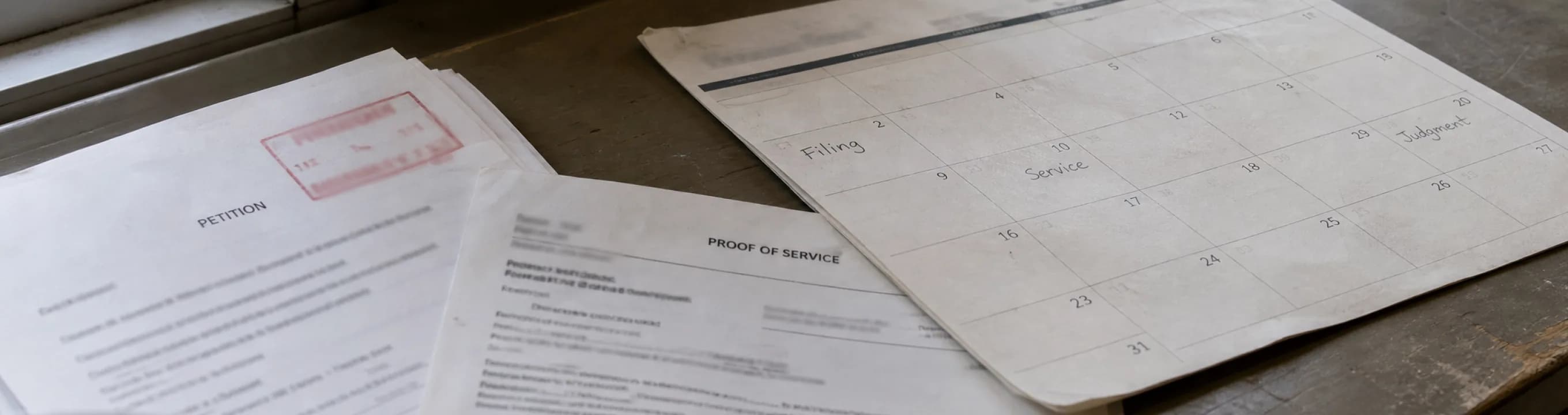
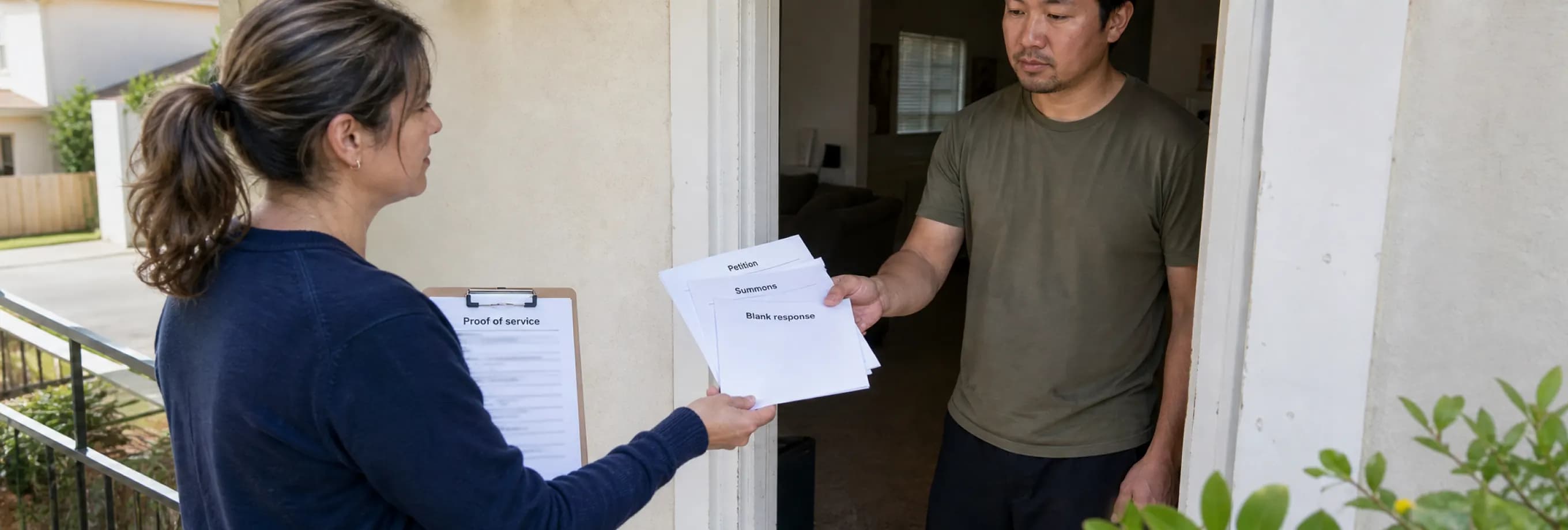
The other spouse must be served with the petition, the summons, a blank response (FL-120) and any attachments. You cannot serve them yourself. An adult who is not a party does it, and completes FL-115, proof of service, which is filed.
This is when the six-month clock starts — on service, or on the respondent's appearance, whichever is first. Not on filing. On a joint petition, filing is service.
Where it goes wrong: a spouse who avoids service is not delaying paperwork, they are holding the clock. Where personal service fails there are alternatives, and they require court approval.
Step 3 — The automatic restraining orders take effect
Printed on the summons and binding both spouses from the start of the case, the ATROs restrict, without written consent or a court order:
- removing minor children from the state;
- changing beneficiaries on insurance policies, or canceling coverage;
- transferring, encumbering, concealing or disposing of property, other than in the ordinary course of business or for the necessities of life.
Nobody applies for these. They simply apply — including to the spouse who filed.
Step 4 — Respond, or do not
The responding spouse has 30 days from service to file FL-120, with its own filing fee (or a waiver). Filing a response starts the six-month clock if service did not.
A spouse who does not respond risks a default: the petitioner may ask the court to proceed without them, and judgment is entered on the terms the petitioner requested, so far as the court finds them supported. Defaults are common and they are frequently the worst outcome available to the person who ignored the envelope.
Step 5 — Financial disclosure (the step people skip)
Required by Family Code sections 2100–2113, in two rounds.
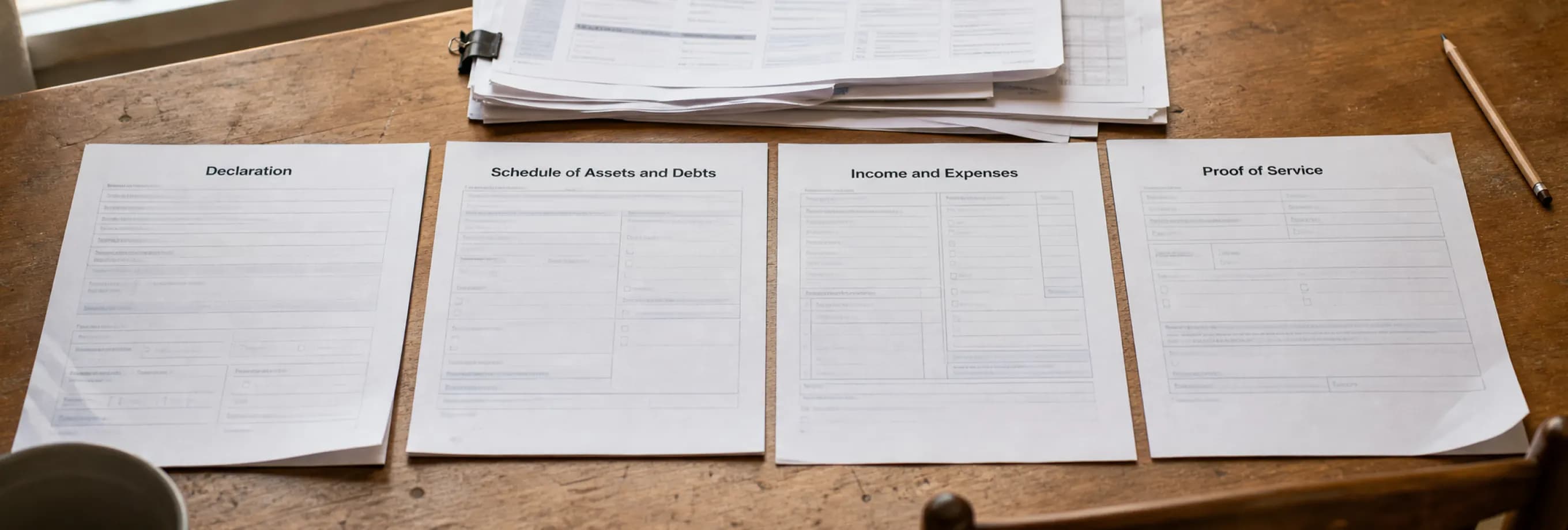
Preliminary declaration of disclosure, served on the other spouse — by the petitioner with the petition or within 60 days of filing it, by the respondent with the response or within 60 days of filing that (Family Code section 2104(f)):
- FL-140 — declaration of disclosure (the cover)
- FL-142 — schedule of assets and debts
- FL-150 — income and expense declaration
- FL-141 — filed with the court to prove the rest were served
Final declaration of disclosure before judgment, which the parties may waive in some circumstances — but the preliminary one they may not.
Where it goes wrong: more judgment packages are rejected over disclosure than over anything else. And the duty is not cosmetic: an asset omitted can reopen a settled case, with the court able to award the other spouse 50% of the omitted asset — or 100% where the omission was fraudulent.
Step 6 — Temporary orders, if you need them now
Nothing about the six months prevents the court from making orders while the case runs. A Request for Order (FL-300) asks for temporary custody, visitation, child or spousal support, attorney fees, or exclusive use of the home, heard on a date the court sets.
People who believe nothing can happen until the divorce is final go months without support they could have asked for in week three. Where there is domestic violence, a DV-100 restraining order request is a separate and faster track.
Step 7 — Settle, or try the case
Most California divorces settle. The agreement is written as a marital settlement agreement and incorporated into the judgment. Where it does not settle, the disputed issues are tried and decided by the judge; there is no jury in California family law.
Property is divided equally — community property, community debt, under Family Code section 2550. Equal does not mean each item is halved; it means the two shares balance.
Step 8 — Judgment
Forms: FL-180 (Judgment) and FL-190 (Notice of Entry of Judgment), plus attachments and the settlement agreement.
The judgment cannot terminate the marriage before six months have run from service or appearance. The court reviews the package; if disclosure is incomplete or the arithmetic does not work, it comes back.
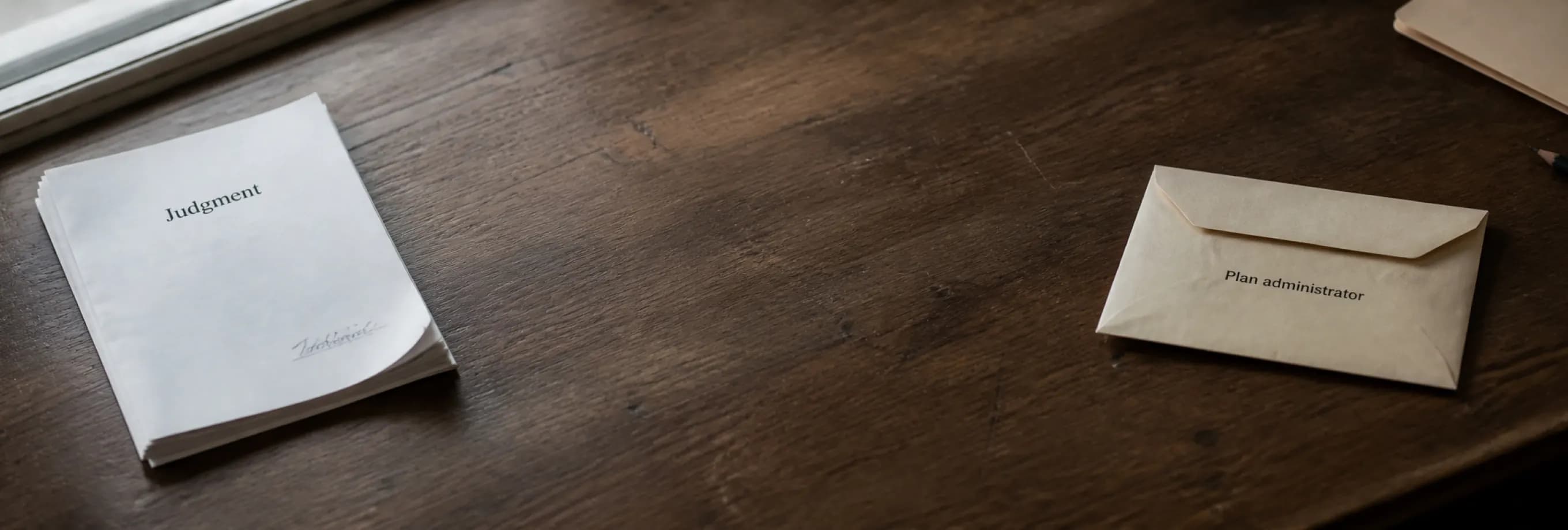
Where it goes wrong — after judgment: an employer retirement plan divided in the judgment — a 401(k), a pension — does not move until an order the plan administrator accepts as a QDRO is in hand, a gap gray divorce and retirement covers in detail. Federal law does not require that to be a separate document; the qualifying language can sit inside the judgment itself, and in practice it is usually drafted as its own order. An IRA is divided by a different mechanism, not a QDRO. Judgments that divide a pension and are never followed by a qualifying order are common, and the problem surfaces years later.
The timeline, in one table
| Step | Forms | Timing |
|---|---|---|
| File | FL-100, FL-110, FL-105 | Day 0 |
| Serve | FL-115 | Starts the six months |
| Respond | FL-120 | 30 days from service |
| Preliminary disclosure | FL-140, FL-141, FL-142, FL-150 | 60 days from filing the petition or the response |
| Temporary orders | FL-300 | Any time the need arises |
| Final disclosure | FL-141 + attachments | Before judgment |
| Judgment | FL-180, FL-190 | No sooner than 6 months from service or appearance |
Doing it yourself, and when not to
California publishes every one of these forms free, with instructions, and every superior court has a self-help center. Every county has a family law facilitator for support calculations. An uncontested divorce with no children and no property is genuinely achievable this way.
The cases where self-representation goes badly share features: a pension or retirement account, a business, real property, a disputed date of separation, a spouse who controls the finances, or any history of abuse. Those produce orders that last decades, and the mistakes are not the kind you notice in time.
This directory lists licensed California family law attorneys by county and practice area, including State Bar certified family law specialists, with their bar record. You contact them directly — we are a directory, not a referral service, and nothing on this site is legal advice.
Of the 5,012 attorneys with an active California license listed in this directory, 3,726 are listed in family law and divorce, spread across 157 California cities. 635 of them are certified by the State Bar's Board of Legal Specialization in Family Law — the one practice claim a public body stands behind.
Common questions
- What are the steps of a divorce in California?
- File a petition and summons; serve them on the other spouse; exchange preliminary financial disclosures; obtain temporary orders if needed; reach an agreement or go to trial; exchange final disclosures; submit a judgment. The marriage cannot end sooner than six months after service.
- What forms start a California divorce?
- FL-100 (Petition) and FL-110 (Summons), plus FL-105 where there are minor children. The fee is about $435 plus any county surcharge, or FW-001 to request a waiver. Since January 1, 2026, spouses who agree may instead file a joint petition on FL-700 and FL-710, for a listed fee of $870.
- Do I have to serve my spouse?
- Yes, and you cannot do it yourself. An adult who is not a party must serve the petition, summons and a blank response form, and then complete FL-115, proof of service, which is filed with the court. A joint petition is deemed served when filed.
- What are the automatic temporary restraining orders?
- Standard orders printed on the summons that bind both spouses once the case begins. They restrict moving children out of state, changing insurance beneficiaries, and transferring or disposing of property outside the ordinary course, without consent or a court order.
- Is financial disclosure required even if we agree?
- Yes. Preliminary and final declarations of disclosure are required by statute. Failing to complete them is one of the most common reasons a judgment package is rejected, and an omission can reopen a case later.
- How long does it take?
- At least six months from service or the respondent's appearance, whichever comes first, and often longer. The six months are a floor on when the marriage can end, not an estimate of when the case will finish.
Sources
Checked on August 16, 2026. Where this page and a court’s own published material disagree, the court is authoritative.
- California Courts Self-Help — The divorce process (opens in a new tab)
- California Courts — find Judicial Council forms (opens in a new tab)
- Family Code section 2339 — six-month waiting period (opens in a new tab)
- Family Code sections 2100–2113 — declarations of disclosure (opens in a new tab)
- Family Code section 2550 — equal division of the community estate (opens in a new tab)
- California Courts Self-Help — Ask for a fee waiver (opens in a new tab)
- California Courts Self-Help — Joint petition for divorce or legal separation (opens in a new tab)