
Definitions of the words that appear in California divorce and bankruptcy paperwork, each tied to the statute or form it comes from. Terms are grouped by subject and alphabetical within each group.
Definitions are general. They are not legal advice, and a term can carry a narrower meaning in a particular case.
Family law
Annulment (nullity) — A judgment declaring that a marriage was never legally valid, as opposed to dissolving a valid one. Available only on specific statutory grounds.
ATROs (automatic temporary restraining orders) — Standard orders printed on the summons, which is FL-110 in a regular case and FL-710 on a joint petition, binding both spouses from the start. Summary dissolution has no summons and so carries no ATROs. They restrict removing children from the state, changing insurance beneficiaries, and transferring or disposing of property outside the ordinary course.
Bifurcation — Severing the issue of marital status so the marriage can be dissolved while property, support and custody remain unresolved. Family Code section 2337, on noticed motion. It cannot produce a status judgment sooner than the six-month minimum.
Community property — Property acquired by either spouse during the marriage, other than by gift or inheritance. Divided equally under Family Code section 2550.
Date of separation — The date of a complete and final break in the marital relationship, requiring both that a spouse expressed the intent to end the marriage and that their conduct was consistent with that intent. Family Code section 70, which also abrogated the case law requiring separate residences — living under one roof does not by itself defeat the date. It fixes the boundary between community and separate property. Why this date and the waiting period do different jobs: California's six-month divorce wait.
Default — What happens when a served respondent does not file a response within 30 days. The case can proceed on the petitioner's terms.
Dissolution — California's term for divorce. The whole sequence is set out in how a divorce works in California.
Declaration of disclosure — The mandatory exchange of financial information, preliminary and final, under Family Code sections 2100–2113. Forms FL-140, FL-141, FL-142 and FL-150.
Earning capacity — What a parent or spouse is capable of earning, which a court may use in place of actual income where consistent with the children's best interests.
Ex parte — An application heard on shortened notice, usually for an emergency. Not a way to get an ordinary request heard faster.
Family law facilitator — A free county office, required by statute, that helps either party with child and spousal support forms and calculations.
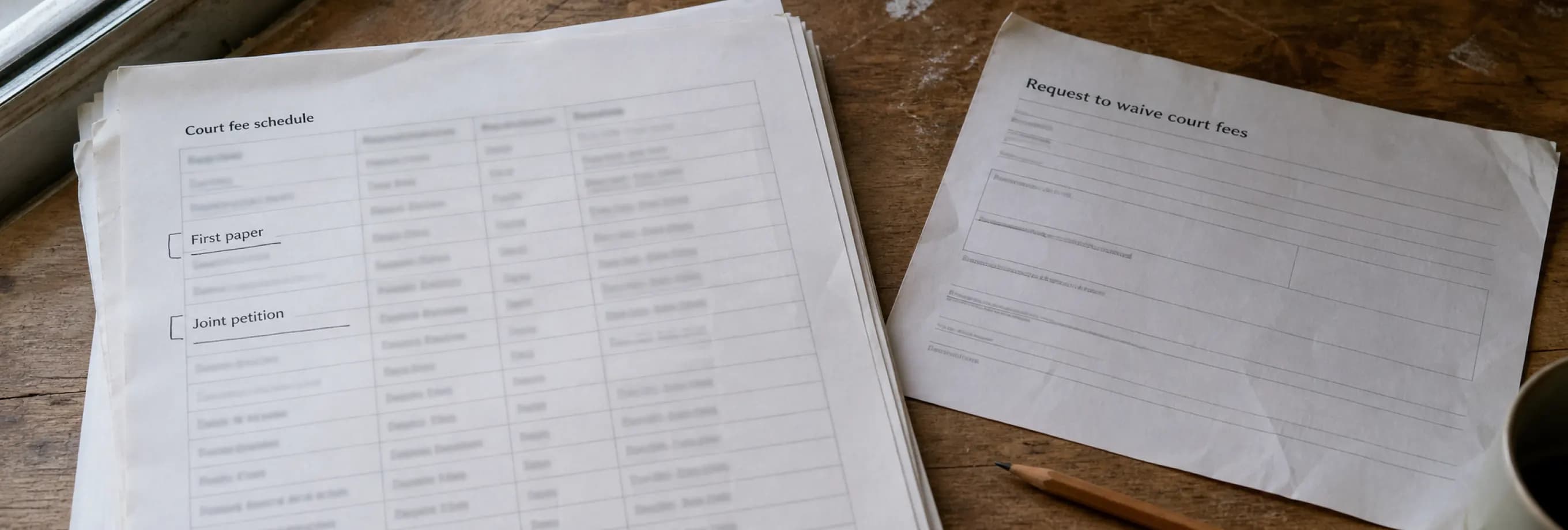
Fee waiver — A request to waive court fees, form FW-001, decided on public benefits, income, or inability to pay for basic needs. What it covers and what it does not: getting divorced when you have no money.
Guideline support — The child support amount produced by the statutory formula in Family Code section 4055, presumed correct under section 4057. The formula and its inputs: how California calculates child support.
H% — In the child support formula, the approximate percentage of time the higher earner has or will have primary physical responsibility for the children, compared with the other parent.
Joint petition — A dissolution or legal separation opened by both spouses on one petition, available since January 1, 2026 under SB 1427. Open to any spouses who agree to file together and expect to reach a full agreement; it carries none of summary dissolution's limits on marriage length, children or property. Deemed served on filing. No temporary orders may be requested while a case stays on this track. Compared with the regular petition in California's joint divorce petition.
Legal custody — Authority to make decisions about a child's health, education and welfare, as distinct from where the child lives.
Legal separation — A judgment that resolves property, support and custody without ending the marriage. No residency period is required to file.
Limited scope representation — An attorney engaged for a defined part of a case rather than the whole of it. Expressly permitted in California family law.
Marital settlement agreement (MSA) — The written agreement resolving a dissolution, incorporated into the judgment.
Physical custody — Where the child lives and the schedule under which each parent has them.
QDRO (qualified domestic relations order) — A court order recognized under 29 U.S.C. § 1056(d)(3), directing an ERISA-covered private employer plan to pay part of a participant's benefit to a spouse, former spouse, child or other dependent. Government systems — CalPERS, CalSTRS, county and federal plans — sit outside that framework and use their own orders. It is usually drafted as its own order, but federal law does not require that: the qualifying language may sit inside the divorce judgment. Without an order the plan accepts as qualified, a judgment dividing a pension moves no money. What closing that gap involves: gray divorce and retirement.
Request for Order (RFO) — Form FL-300, the motion used to ask for temporary or modified orders on custody, support, fees or use of property.
Respondent — The spouse who did not file the petition. On a joint petition there is no respondent.
Section 2030 fees — A need-based order that one party pay the other's attorney fees where there is a disparity in access to funds and one party can pay.
Separate property — Property owned before marriage, acquired by gift or inheritance, or acquired after the date of separation, plus its rents and profits.
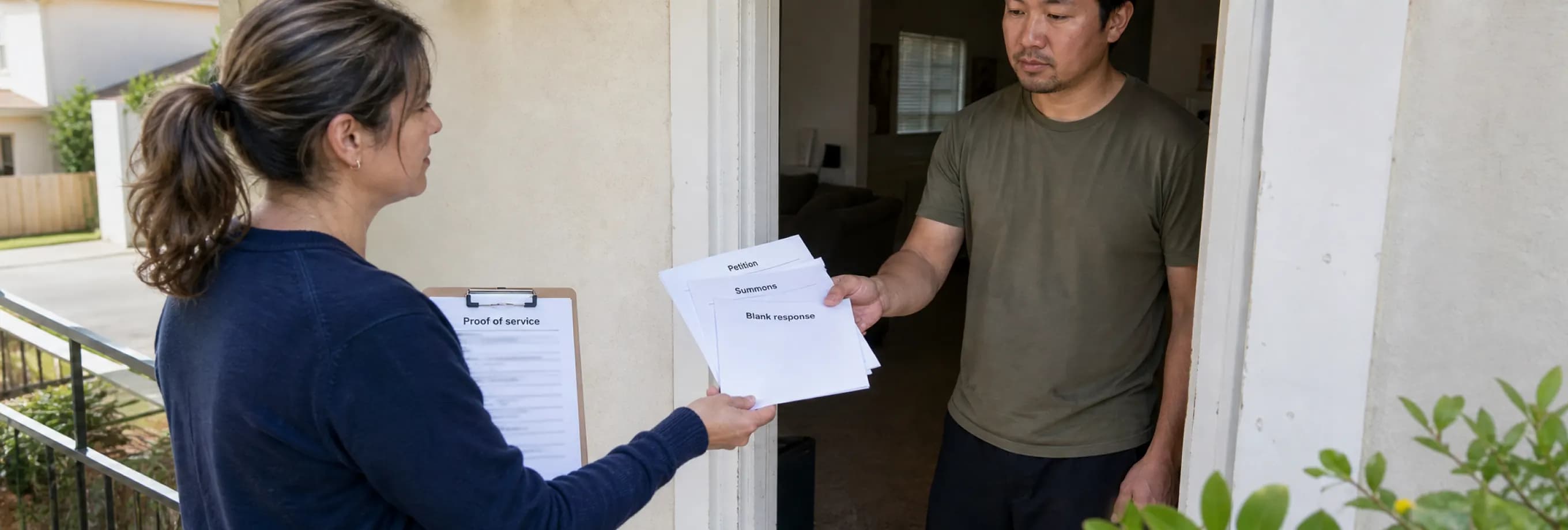
Service — Formal delivery of the petition and summons by an adult who is not a party, proved on form FL-115. Other routes exist where personal service is impractical, including mail with a written acknowledgment of receipt and, by court order, service by publication. It starts the six-month clock — or the respondent's appearance does, whichever comes first. On a joint petition or a summary dissolution nobody is served, and filing does both.
Summary dissolution — A short-form divorce for short marriages with no children and limited property and debt, ending without a hearing. Its fee and conditions sit alongside the others in what a divorce costs in California.
Timeshare — The proportion of parenting time each parent has, used in the support formula.
Transmutation — An agreement changing the character of property between community and separate. Must generally be in writing.
Bankruptcy
341 meeting (meeting of creditors) — The examination required by 11 U.S.C. § 341, conducted by the trustee about a month after filing. The filer is under oath; creditors may attend and usually do not.
Adversary proceeding — A lawsuit filed inside a bankruptcy case, with its own complaint and judgment. Required to establish undue hardship for student loans.
Automatic stay — The injunction under 11 U.S.C. § 362 that stops collection on filing. Exceptions in § 362(b)(2) leave most family law proceedings and support enforcement running. For someone who had a case dismissed within the previous year the stay can lapse after 30 days unless the court extends it, and a creditor can always move for relief from it.
Chapter 7 — Liquidation. Non-exempt property is realized by a trustee; dischargeable debts are wiped out. Most consumer cases are no-asset cases. Step by step: how Chapter 7 works in California.
Chapter 13 — Reorganization for individuals with regular income, through a three or five year repayment plan.
Confirmation — Court approval of a Chapter 13 plan.
Credit counseling — The briefing from an approved agency required within the 180 days before filing.

Current monthly income — For the means test, the average monthly income over the six full calendar months before the month of filing. Excludes Social Security benefits.
Debtor education — The personal financial management course required after filing and before discharge, certified on Form 423.
Discharge — The order releasing personal liability for dischargeable debts. It does not remove liens.
Disposable income — Income remaining after allowed expenses, calculated on Form 122A-2 in Chapter 7 and used to set the payment in a Chapter 13 plan.
Domestic support obligation — Defined in 11 U.S.C. § 101(14A): a debt owed to or recoverable by a spouse, former spouse, child or governmental unit that is in the nature of alimony, maintenance or support, established by an agreement, decree or order — expressly without regard to whether it is labeled that way. Not dischargeable under § 523(a)(5) and a first-priority claim under § 507(a)(1). How it interacts with a divorce judgment: bankruptcy and divorce in California.
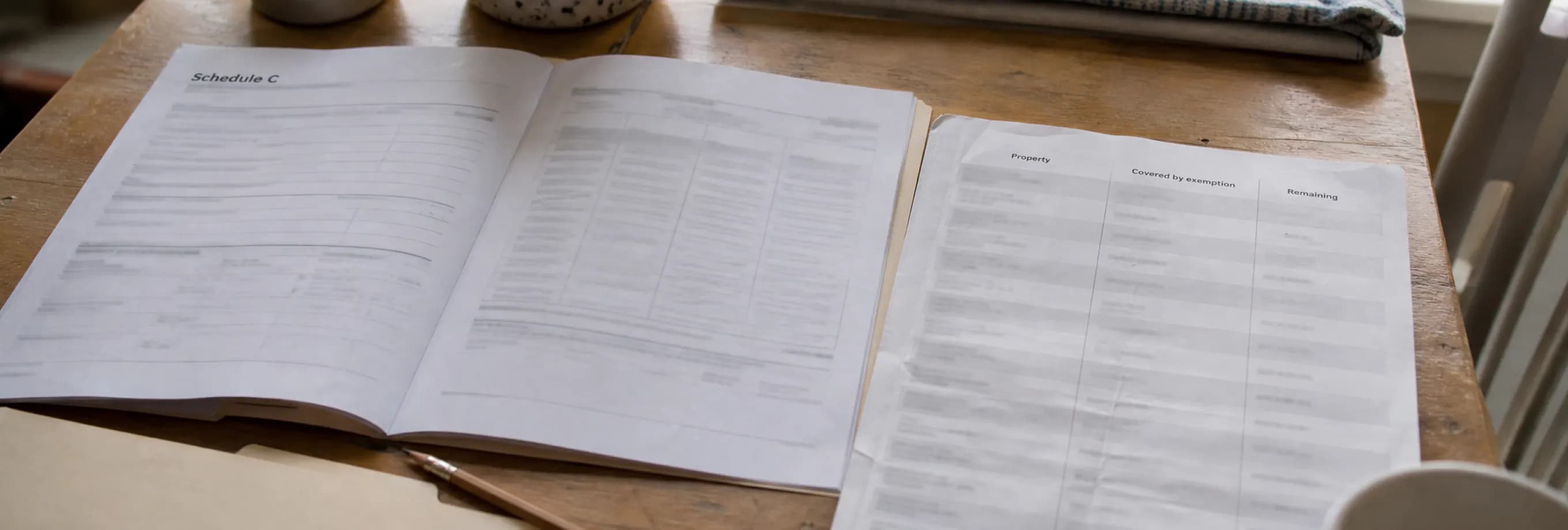
Exemption — A statutory protection that keeps property out of the reach of the trustee and of judgment creditors. California requires electing either the 703 or the 704 system for the whole case, and the election is made on Schedule C. The two cannot be mixed. Compared side by side in how the 703 and 704 systems differ.
Homestead exemption — The protection for equity in a principal residence. Under CCP 704.730 it is set by the prior year's countywide median sale price, between $370,650 and $741,300 for exemptions claimed in 2026, and adjusts annually for inflation. The 2026 calculation, shown step by step: California's 2026 homestead exemption.
Lien — A creditor's interest in specific property. It survives a discharge unless separately avoided or released.
Means test — The calculation under 11 U.S.C. § 707(b) determining whether Chapter 7 relief would be an abuse. It reaches individual debtors whose debts are primarily consumer debts. First a comparison to state median income, then a disposable income calculation. Worked through in the Chapter 7 means test after a job loss.
No-asset case — A Chapter 7 in which the trustee finds nothing worth realizing after exemptions. The ordinary outcome in consumer cases.
Non-dischargeable debt — A debt that survives the discharge, listed in 11 U.S.C. § 523: support, most taxes, most student loans, DUI injury debts, criminal fines and others.
Preference — A payment to a creditor within a lookback period before filing that the trustee can recover so that creditors are treated equally. Payments to family members have a longer lookback.
Priority claim — A claim paid ahead of general unsecured claims, ranked by 11 U.S.C. § 507.
Reaffirmation — An agreement to remain liable on a debt that would otherwise be discharged, usually to keep collateral. It requires court scrutiny and is not the only way to keep a car.
Redemption — Paying a secured creditor the replacement value of collateral in a lump sum to keep it, rather than the balance owed.
Relief from stay — A creditor's motion asking the court to lift or modify the automatic stay, commonly to proceed with a foreclosure or repossession. 11 U.S.C. § 362(d).
Schedules — The sworn lists of assets, debts, income, expenses and transfers filed with the petition. Signed under penalty of perjury.
Secured debt — A debt backed by collateral, such as a mortgage or car loan.
Statement of financial affairs — Form 107, the disclosure of transfers, lawsuits, payments and financial history preceding the filing.
Trustee — The person appointed to administer the estate: in Chapter 7, to identify and realize non-exempt property; in Chapter 13, to administer plan payments.
Undue hardship — The standard under 11 U.S.C. § 523(a)(8) for discharging student loans, set out with the current repayment rules in student loans and bankruptcy after SAVE. It is usually applied through the Brunner test and established in an adversary proceeding.
Unsecured debt — A debt with no collateral behind it, such as a credit card balance or medical bill.
Wildcard exemption — Under CCP 703.140(b)(5), $1,950 plus any unused part of the $36,750 residence exemption, applicable to any property. It exists only in the 703 system; 704 has no equivalent. For a filer who uses none of the residence exemption that comes to $38,700. Amounts from form EJ-156, for cases commenced April 1, 2025 through March 31, 2028.
A note on how to use this
Definitions orient you; they do not decide anything. A term like date of separation or undue hardship has a settled general meaning and a contested application in real cases, and the difference between the two is where the outcome lives.
For procedure, see how a divorce works in California and how Chapter 7 works in California. For counsel, this directory lists licensed California attorneys by county and practice area with their State Bar record.
These words describe two systems this directory covers: 3,726 California attorneys listed in family law and divorce, 1,523 in bankruptcy, at 3,140 firms across 157 cities.
Sources
Checked on August 16, 2026. Where this page and a court’s own published material disagree, the court is authoritative.
- California Courts Self-Help (opens in a new tab)
- California Family Code (opens in a new tab)
- California Code of Civil Procedure, enforcement of judgments (opens in a new tab)
- United States Courts — bankruptcy basics glossary (opens in a new tab)
- United States Bankruptcy Code, 11 U.S.C. (opens in a new tab)