
The court found that domestic violence occurred. Does that end the custody case? No. It changes the starting point for the hearing that follows. Under Family Code section 3044, an award of sole or joint legal or physical custody to the person who committed the violence is presumed detrimental to the child. The finding has to fit the statute's shape: domestic violence perpetrated within the previous five years by a party seeking custody, against the other party seeking custody, against the child or the child's siblings, or against a person named in section 3011 with whom that party has a relationship.
The result is not an automatic no-contact order. It is a shift in the burden of proof, followed by findings the judge must make before awarding custody. It sits inside the ordinary case described in how a divorce works in California. The preference for frequent contact with both parents cannot supply the missing proof.
If you are in danger now, call 911 or seek safety. The California Courts domestic violence guide lists free court help and the National Domestic Violence Hotline at 800-799-7233. Online activity can remain visible through browser history, device records, or monitoring software; if that is a concern, use a device someone else does not control. This page provides general legal information, not advice about a custody or safety plan.
The court finding controls the next step
Section 3044 applies after a court finds that the person seeking custody perpetrated domestic violence. An allegation alerts the court to an issue it must address; it does not make the finding by itself.
A criminal conviction is one way the requirement is met, but only a qualifying one: section 3044(d)(1) points to a conviction within the previous five years, after trial or a plea of guilty or no contest, of a crime against the other party that falls within the statutory definitions of domestic violence and abuse. A conviction is not required at all. The family judge may decide the issue from admissible evidence presented in the custody proceeding, and under section 3044(d)(2) a finding made under subdivision (a) by another court satisfies the requirement too, whether or not that court heard the custody case, so long as the conduct falls within the five years.
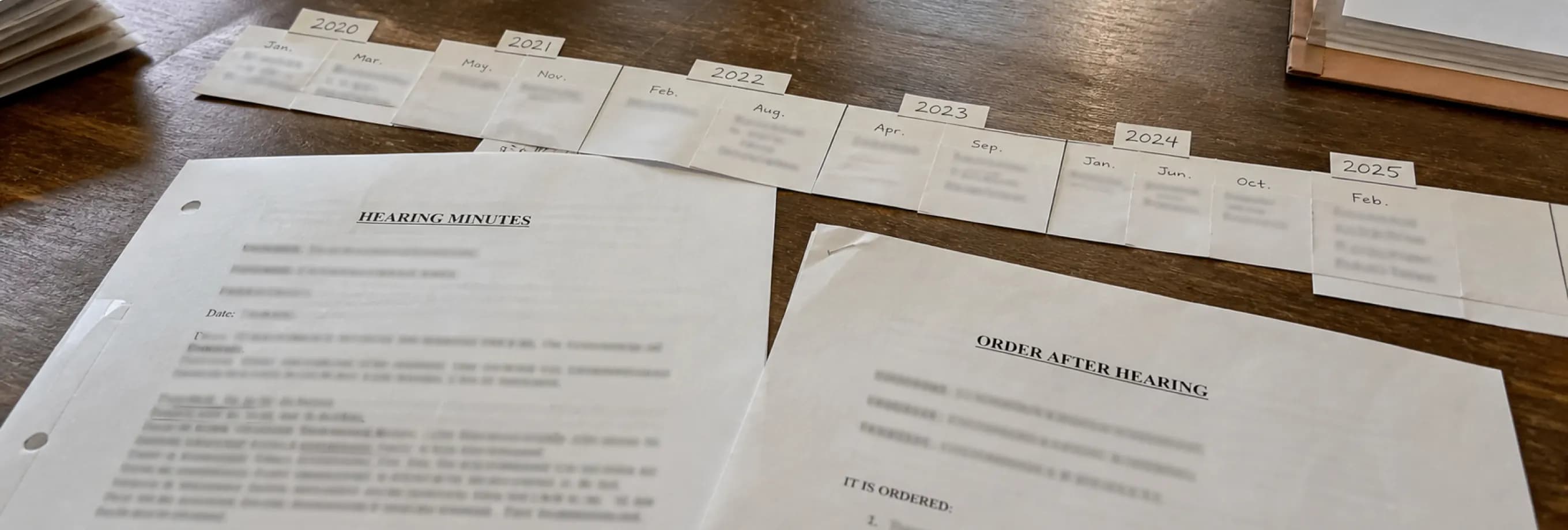
This distinction matters when the file contains a temporary restraining order, hearing minutes, or an order after hearing. The label on a document does not answer every question. Read the order for the court's findings and the dates attached to the conduct. Section 3044 also says the judge may not base a domestic-violence finding solely on a custody evaluator's conclusions or a Family Court Services recommendation.
The hinge is the court's finding and the date of the conduct. The existence of a criminal case is secondary.
At an evidentiary hearing or trial where domestic violence has been alleged and custody is sought, the court must decide whether section 3044 applies before issuing a custody order. If a continuance is needed to decide that question, the statute permits a temporary custody order for a reasonable period, provided it complies with sections 3011 and 3020.

Once section 3044 applies, the burden moves
The person found to have committed domestic violence must rebut the presumption by a preponderance of the evidence. That means showing that it is more likely than not that awarding custody is in the child's best interest under sections 3011 and 3020.
That best-interest finding is only the first gate. The court must also find that the seven additional factors, on balance, support the legislative findings in section 3020. That phrase is the reason completion of one program does not decide the motion: the factors are weighed together, not counted.
| Statutory factor | What the record may need to show |
|---|---|
| Batterer's treatment | Whether the perpetrator successfully completed a program meeting Penal Code section 1203.097(c) |
| Alcohol or drug counseling | Completion, if the court found counseling appropriate |
| Parenting education | Completion, if the court found a class appropriate |
| Probation or parole | Whether the person complied with the applicable terms |
| Protective or restraining orders | Whether an order exists and whether its terms were followed |
| Later conduct | Whether the person committed further domestic violence |
| Firearms or ammunition | Whether the court determined, under section 6322.5, that the restrained person possessed or controlled a firearm or ammunition in violation of Family Code section 6389, Code of Civil Procedure section 527.9, or Penal Code section 18120 — ownership without that finding is not the factor |
One argument is unavailable by statute. The person seeking custody cannot overcome section 3044 by relying, in whole or in part, on California's general preference for frequent and continuing contact with both parents. The court still decides the child's best interest; it simply cannot use that preference as the reason the presumption was rebutted.
The judge must leave a usable record
If the court decides that the presumption has been overcome, it must make specific findings on each statutory factor. It must also state, in writing or on the record, why custody is in the child's best interest and why the additional factors, taken together, support the policies in Family Code section 3020.
That requirement predates 2026. The new form FL-351, effective January 1, 2026, is an optional Judicial Council form for recording the required reasons after a hearing. A court can instead put its reasons in another written order or state them on the record — section 3044(f)(2) asks for them in writing or on the record, not on any particular form. The form is new; it documents the duty rather than creating it, and the duty is not new.
For someone leaving a hearing, the practical question is whether the record contains the ruling the statute calls for. A proposed custody order that says only “best interest” may omit the factor-by-factor work section 3044 requires.

What the 2026 amendment actually changed
SB 899 was enacted in 2024 and became effective on January 1, 2025. The replacement section 3044 had a later operative date: January 1, 2026. Read against the version it replaced, the change here is one of width rather than of new ground.
The firearm-and-ammunition factor is the clear case. It existed before 2026, reaching violations of Family Code section 6389; the operative version widened it to reach Code of Civil Procedure section 527.9 and Penal Code section 18120 as well. Either way the wording is narrower than a general question about whether someone owns a gun: the factor asks whether the court has determined, under Family Code section 6322.5, that a restrained person possessed or controlled a firearm or ammunition in violation of one of those statutes. Ownership without that violation finding is not what section 3044(b)(2)(G) says.
The factor about compliance with a protective or restraining order is sometimes reported as a 2026 change too. That is checkable: SB 899 carries both versions of section 3044, the one it repealed in section 6 of the bill and the one it added in section 7, and the wording of that factor is the same in each. Summaries of the legislation describe it as new; the enacted text is what a court applies.
What the amendment did not do is create the duty to make findings, which section 3044(f)(1) codifies from case law that predates it. Describing that duty as a new 2026 rule overstates the amendment.
Custody and parenting time remain separate decisions
Section 3044 names sole or joint physical custody and sole or joint legal custody. It does not create an automatic ban on visitation. Depending on the evidence and the child's safety, a court may order supervised visits, a structured exchange, virtual contact, or no visitation.
The distinction does not make parenting time casual. Under Family Code section 3011, when abuse allegations are before the court and it grants sole or joint custody or unsupervised visitation to the accused parent, the court must state why the order serves the child's best interest and protects the parties and the child. The order must also be specific about the time, place, and manner of exchanges.
Before the next hearing, identify the missing piece
The domestic-violence hearing is over and custody is next. The useful preparation is a short audit of the actual record:
- the order or minutes containing the domestic-violence finding;
- the dates and conduct on which the finding rests;
- the current custody and visitation orders;
- documents that bear on the applicable section 3044 factors;
- the proposed order, with a place for the court's required findings.
California court self-help centers provide free procedural help and forms. They do not represent either party or decide how evidence should be framed. For someone handling the filing without full representation, the limited job to buy is a prehearing review of the domestic-violence findings, the custody request and the proposed order. Ask for a written issue list at the end; that gives the consultation a finish line without turning it into a trial retainer.
AttorneyIndex is a directory, not a referral service. It lists licensed California family law attorneys by county, shows State Bar information and certified-specialist status where available, and lets you contact attorneys directly. At the next custody hearing, the domestic-violence finding is the starting point. The proposed order needs to show the rest of the court's work.
Section 3044 changes who has to prove what, and the proof runs through statutory factors and written findings. Of the 3,726 California attorneys who list family law in this directory, 635 are State Bar certified specialists in Family Law — a credential, not a count of everyone competent to handle such a hearing.
Common questions
- What is the Family Code section 3044 presumption?
- When a California court finds that a person seeking custody committed domestic violence within the previous five years, section 3044 presumes that awarding that person sole or joint legal or physical custody would harm the child's best interest. The person seeking custody must overcome that presumption by a preponderance of the evidence.
- Does section 3044 automatically end all contact with the child?
- No. The statute addresses sole or joint legal and physical custody. It does not itself prohibit visitation. A court may order supervised, structured, virtual, or no visitation based on the child's safety and best interest.
- Is a criminal conviction required for section 3044 to apply?
- No. The family court can make the required finding from admissible evidence in the custody case. A qualifying criminal conviction or a domestic-violence finding made by another court may also satisfy the requirement if the underlying conduct occurred within the five-year window.
- What must the court consider before awarding custody?
- The court must find that custody is in the child's best interest and must also find that seven additional statutory factors, on balance, support the legislative findings in section 3020. They cover treatment, counseling or parenting classes where applicable, compliance with probation or parole and protective orders, further domestic violence, and a qualifying firearm or ammunition violation.
- Can California's preference for contact with both parents overcome the presumption?
- No. Section 3044 expressly bars the court from using the preference for frequent and continuing contact with both parents, or contact with a noncustodial parent, to rebut the presumption in whole or in part.
- What changed in section 3044 in 2026?
- SB 899 was enacted in 2024 and took effect on January 1, 2025, and its replacement section 3044 became operative on January 1, 2026. The firearm-and-ammunition factor already existed; the operative version widened it to reach violations of Code of Civil Procedure section 527.9 and Penal Code section 18120 alongside Family Code section 6389. The duty to make specific findings when the presumption is overcome also already existed. Form FL-351, new in 2026, gives courts an optional way to record those findings.
Sources
Checked on August 16, 2026. Where this page and a court’s own published material disagree, the court is authoritative.
- Family Code section 3044 — custody presumption after domestic violence (opens in a new tab)
- Family Code section 3011 — best-interest findings (opens in a new tab)
- Penal Code section 1203.097 — batterer's treatment program standards (opens in a new tab)
- SB 899 (2024) — the section 3044 text operative January 1, 2026 (opens in a new tab)
- California Courts form FL-351 — Mandatory Findings for Child Custody and Visitation Orders (optional form) (opens in a new tab)
- California Courts Self-Help — domestic violence and child custody (opens in a new tab)
- California Courts Self-Help — domestic violence restraining orders (opens in a new tab)