
- Official title
- Summons (Family Law)
- Issued by
- Judicial Council of California
- Revision
- Rev. January 1, 2015
- Use
- Mandatory
- Official PDF
- FL-110 on www.courts.ca.gov
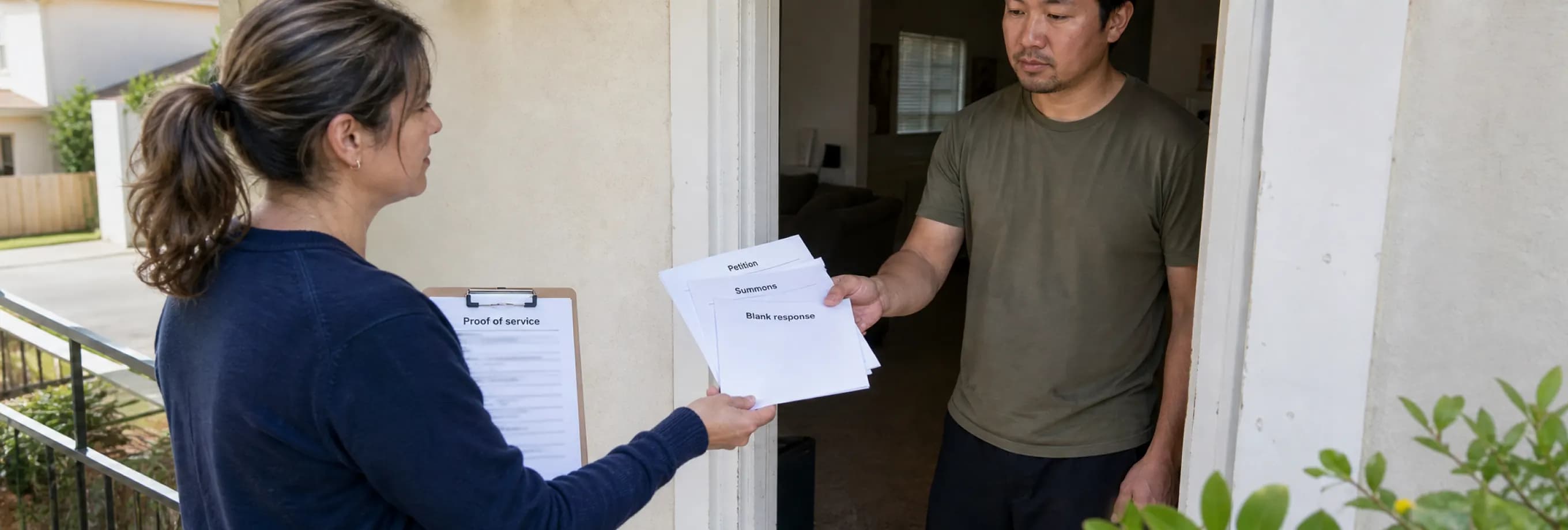
An envelope arrives with a filed petition and a document headed “Summons.” FL-110 is the notice that sets out what the respondent must do next and places both parties under the standard family-law restraining orders. The court clerk issues the summons when the petition is filed. It is then served together with that petition.
The current FL-110 became effective January 1, 2015. It is a two-page mandatory Judicial Council form. Its footer reads “Form Adopted for Mandatory Use, FL-110 [Rev. January 1, 2015]” and cites Family Code sections 232, 233, 2024.7, 2040, and 7700, along with Code of Civil Procedure sections 412.20 and 416.60–416.90. Arabic, Chinese Simplified, Korean, and Vietnamese translations are available for reference; the English form is filed.
This page explains the statewide summons and the notices printed on it. It is general information, not legal advice about how to respond or what orders may be entered in a particular case.
What does the 30-day notice require?
FL-110 gives the respondent 30 calendar days after the Summons and Petition are served to file a Response, FL-120, with the court and have a copy served on the petitioner. The form warns that a letter, phone call, or court appearance will not protect the respondent.
If a Response is not filed on time, the form says the court may make orders affecting the parties' marriage or domestic partnership, their property, and custody of their children. It also says the respondent may be ordered to pay support, attorney fees, and costs. The court named on the first page is the filing court; the statewide court directory leads to county court information.
What do the page 2 restraining orders cover?
The standard family-law restraining orders under Family Code section 2040 cover four categories:
- Taking the parties' minor children out of California or applying for a new or replacement passport for them without the other party's prior written consent or a court order
- Cashing, borrowing against, canceling, transferring, disposing of, or changing beneficiaries of insurance or other coverage held for the parties or their minor children, including life, health, automobile, and disability coverage
- Transferring, encumbering, hypothecating, concealing, or otherwise disposing of real or personal property—whether community, quasi-community, or separate—without written consent or a court order, except in the usual course of business or for the necessities of life
- Creating or changing a nonprobate transfer in a way that affects the property's disposition without written consent or a court order; the form also requires notice to be filed and served before revocation takes effect or a survivorship right is eliminated
The form says they start immediately. Family Code section 233 puts the timing in statute: the orders are in effect upon filing the petition and issuance of the summons, and upon its service on the respondent, and they remain in effect until judgment is entered, the petition is dismissed, or the court makes further orders. FL-110 says a California law-enforcement officer who has received or seen a copy may enforce them anywhere in the state.
The same page requires each party to give the other at least five business days' notice before a proposed extraordinary expenditure and to account to the court for extraordinary expenditures made after the orders take effect. It allows community, quasi-community, or separate property to be used to pay an attorney or court costs.
What other notices appear on FL-110?
The health-insurance notice directs a person who needs affordable coverage for themselves or someone in the household to apply through Covered California. It says Covered California can help reduce the amount paid toward coverage and provides coveredca.com and 1-800-300-1506 for more information.
The fee-waiver notice says a person who cannot pay the filing fee may ask the clerk for a fee-waiver form. It also warns that the court may order repayment of all or part of fees and costs waived for either party. For legal advice, the summons says to contact a lawyer immediately and lists the California Courts Online Self-Help Center, California Legal Services, and the local county bar association as places to seek help finding one.
For the respondent holding the newly served papers, a limited-scope consultation can focus on the Response and the orders already in effect. AttorneyIndex is a directory; readers may browse family law attorneys in Los Angeles without the directory selecting or recommending one.
Common questions
- What is California form FL-110?
- FL-110 is the mandatory Judicial Council summons in a California family-law case. The clerk issues it when the petition is filed, and it is served with the petition.
- How long does the respondent have to file a response?
- The form gives the respondent 30 calendar days after the Summons and Petition are served to file FL-120 and have a copy served on the petitioner.
- What happens if no response is filed within 30 days?
- FL-110 says the court may make orders affecting the marriage or domestic partnership, property, and child custody. The respondent may also be ordered to pay support, attorney fees, and costs.
- When do the standard restraining orders take effect?
- They take effect for the petitioner when the petition is filed and for the respondent when the Summons and Petition are served. They continue until judgment, dismissal, or a further court order.
- Is FL-110 available in other languages?
- California Courts provides Arabic, Chinese Simplified, Korean, and Vietnamese translations for reference. The English form is filed with the court.
Sources
Checked on September 22, 2026. Where this page and a court’s own published material disagree, the court is authoritative.
- Judicial Council of California — Form FL-110 (opens in a new tab)
- California Courts Self-Help — Form FL-110 information (opens in a new tab)
- Family Code section 233 — when the summons restraining orders take effect (opens in a new tab)
- Family Code section 2040 — standard family-law restraining orders (opens in a new tab)