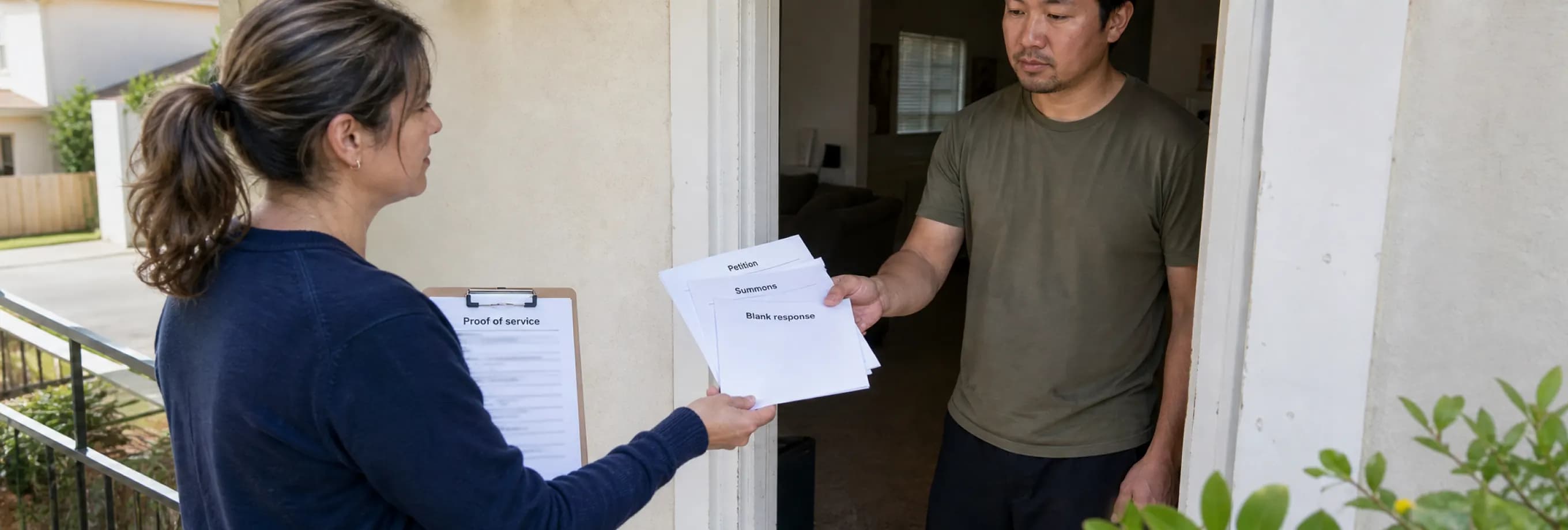

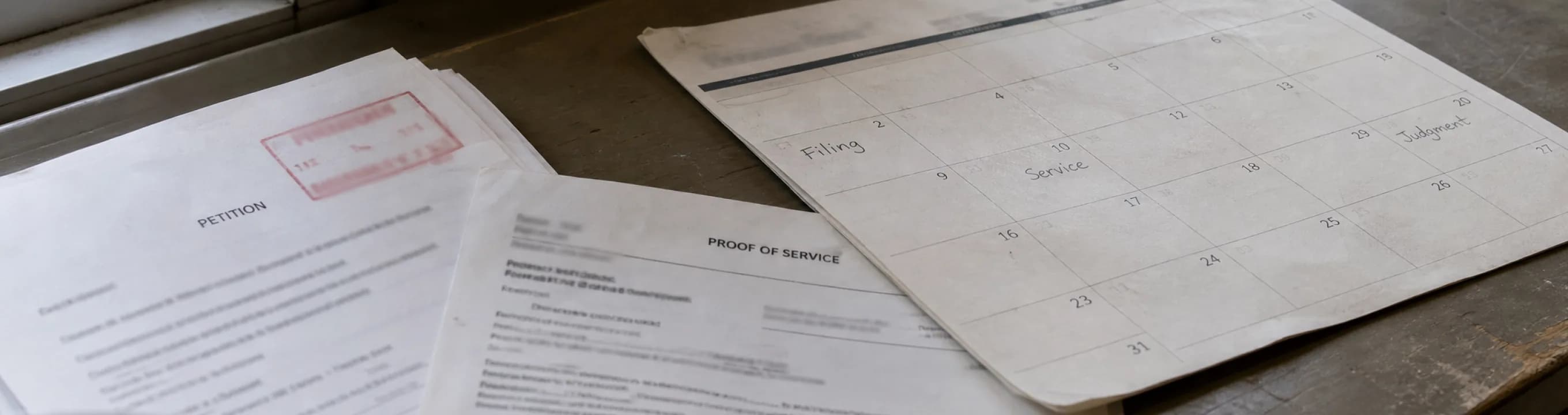
The petition was filed on February 3. The proof of service says March 18. If those are the only events on the docket, February 3 is the wrong date for the six-month calculation.
For a regular California divorce, Family Code section 2339 runs from the date the respondent was served with a copy of the summons and petition or the date the respondent appeared in the case, whichever occurred first. Filing starts the case. It does not, by itself, start this clock.
The period answers one narrow question: the earliest point at which a judgment may terminate marital status. It does not automatically finish the divorce, stop the spouses from negotiating, or prevent temporary orders while a regular case is pending.
This guide provides general information about California procedure. It does not calculate a date for a particular case or predict when a court will enter judgment.
Put the jurisdiction date next to the filing date
Family Code section 2339 states that no dissolution judgment is final for the purpose of terminating the marriage until six months have expired from service of a copy of the summons and petition or the respondent's appearance, whichever occurred first. The court may extend that period for good cause. The section does not give the court authority to shorten it.
Keep the filing date in the file because it matters to the case, but label the dates separately:
- Filing date: when the court opened the case.
- Jurisdiction date: the earlier of service of the summons and petition or the respondent's appearance.
- Status-termination date: the date stated in the judgment when the marriage ends.
That third date requires a judgment. Family Code section 2340 requires the judgment to specify when it becomes finally effective for terminating the marriage. Reaching the end of six months without an entered judgment does not change either spouse's marital status.
The joint-petition process has a different starting event. Under Family Code section 2331, a filed joint petition and joint summons are deemed served on both parties, and both parties are deemed to have appeared. California Courts therefore instructs joint petitioners that the six-month period begins when they file. That is a feature of the joint filing, not a reason to use the filing date in a regular petition case.
The joint petition is easy to confuse with summary dissolution, and the two are different routes. Summary dissolution is the short-form divorce with narrow conditions — a short marriage, no children together, little property. The joint petition carries none of those limits; it is open to spouses who agree, whatever the length of the marriage or the size of the estate. The statewide fee schedule treats them as separate items for that reason, listing the joint petition at $870 and expressly excepting summary dissolution, which has its own $435 line.
The case can move while marital status waits
Section 2339 restricts the effective date of a judgment that ends the marriage. It does not impose a six-month pause on disclosures, document exchange, settlement discussions, or preparation of a written agreement. California Courts places agreement work and preparation of final judgment papers inside the active divorce process, including during the waiting period.
In a regular divorce, either side may also use Request for Order (form FL-300) to ask for temporary decisions while the case is ongoing. Depending on the issues raised, those requests can concern child custody and parenting time, child or spousal support, control of property, or attorney's fees. The six-month status rule does not postpone that procedure.
The qualification matters for a joint petition. California Courts states that temporary orders cannot be requested while the case remains in the joint-petition process. If either spouse revokes that process and the case proceeds as a regular divorce, the rules for requesting temporary orders then apply. The waiting period and the availability of interim relief are separate questions.
An agreement also does not make the marriage end automatically. The spouses still need the required final papers and an entered judgment. The court determines whether to approve the proposed orders; the calendar alone does not supply that decision.
“The court may extend the six-month period described in subdivision (a) for good cause shown.”
— Family Code section 2339(b)
The other date, and the one that usually matters more
The six-month clock is a procedural minimum. The date of separation is a substantive fact, and the two are routinely confused because both feel like "when the marriage ended."
Family Code section 70 defines the date of separation as the date a complete and final break in the marital relationship occurred, shown by both of two things: one spouse expressed to the other the intent to end the marriage, and that spouse's conduct was consistent with the intent. In determining it, the court shall take into consideration all relevant evidence.
Both halves have to be there. A stated intention followed by conduct that still looks married is where this date gets litigated, and it is why the conversation someone remembers having is rarely the end of the argument.
One point defeats a common assumption. Section 70 states that the Legislature enacted it to abrogate In re Marriage of Davis (2015) 61 Cal.4th 846 and In re Marriage of Norviel (2002) 102 Cal.App.4th 1152. Davis had required living in separate residences. Under the current statute, separate residences are not a prerequisite — the question is the complete and final break, proved by expression and conduct, on all relevant evidence.
The date carries real consequences: under section 771, the earnings and accumulations of a spouse after the date of separation are that spouse's separate property. The statute says "earnings and accumulations" and no more, so how any particular bonus, equity award, or business change is treated is a question of characterization on the facts, not something section 771 answers by listing categories. The recurring fights are over things earned on one side of the line and paid on the other — a bonus for pre-separation work that lands afterwards, equity granted during the marriage that vests later, a business whose value moved in between.
Two dates, two jobs. Service or appearance starts the six-month status clock. Separation fixes a line in the property record. A case can have a late service date and an early separation date, or the reverse.
Bifurcation separates status from unfinished issues
Sometimes the six months have expired and the property, support, or other issues are still not ready for final judgment. Family Code section 2337 allows the court, on noticed motion, to sever marital status for a separate trial. This is commonly called status bifurcation. If granted, the status judgment must expressly reserve the remaining issues for later.
Bifurcation does not move the section 2339 date forward. California Courts states that marital status still cannot end before the six-month period expires.
One consequence is worth raising with a tax preparer before the motion rather than after: filing status for a tax year turns on marital status at the end of that year, so ending the marriage in December rather than January changes which returns the spouses can file. Section 2337 lets the court attach conditions covering tax and other consequences, which is the mechanism for handling this rather than a reason it cannot happen.
The safeguards are more exact than a general promise to deal with finances later. Section 2337 requires the moving party to serve a preliminary declaration of disclosure with the motion unless it was served earlier or the parties stipulated in writing to defer it. The court may impose conditions addressing consequences such as taxes, health coverage, probate rights, or Social Security rights. For retirement or pension plans, the statute also contains mandatory joinder and claim-preservation requirements, subject to the exceptions stated in the section. Form FL-315 records the requested conditions; form FL-347 records the court's status-bifurcation orders.
That keeps a limited-scope review bounded without asking anyone to take over the case: review the jurisdiction date and proposed status-only papers, including which section 2337 safeguards apply. AttorneyIndex is a directory, not a matching or referral service. Readers choose which California family law attorney listings to review, check the linked State Bar information, and contact an attorney directly; the directory does not select or recommend one.
Return to the February 3 petition and the March 18 proof of service. They belong on the same timeline, but they do different work. For the regular case described at the start, March 18 is the section 2339 trigger. The eventual judgment will supply the date that actually ends the marriage.
Six months is a floor, not a schedule. The 3,726 family-law attorneys listed here work across 157 California cities, and local practice — how a county sets hearings, how it handles judgment packets — is the part no statute tells you.
Common questions
- When does California's six-month divorce period start?
- In a regular divorce, it starts on the date the respondent was served with a copy of the summons and petition or appeared in the case, whichever occurred first. Filing the petition alone does not start the period.
- Does a California divorce become final automatically after six months?
- No. The period sets the earliest date marital status can end. The court must enter a judgment, and that judgment must state when termination of marital status becomes effective.
- Can the court shorten the six-month period?
- Family Code section 2339 provides for an extension upon a showing of good cause. It does not give the court authority to shorten the period.
- Can temporary orders be made during the six-month period?
- Yes, in a regular divorce either side can request temporary orders while the case is pending. California's joint-petition process does not permit temporary-order requests unless the case changes to the regular process.
- What is the date of separation, and is it the same as the six-month clock?
- No, they are different. Family Code section 70 sets the date of separation at the complete and final break in the marital relationship, shown by expressed intent to end the marriage and conduct consistent with it, on all relevant evidence. Living in separate residences is not required; section 70 abrogated the case that had said otherwise. It matters because under section 771 a spouse's earnings and accumulations after that date are separate property.
- Can marital status end before property and support issues are resolved?
- A court may grant a separate trial on marital status, called bifurcation, while reserving the remaining issues. Bifurcation does not shorten the six-month minimum and carries disclosure and protective requirements.
Sources
Checked on August 16, 2026. Where this page and a court’s own published material disagree, the court is authoritative.
- Family Code section 2339 — six-month period (opens in a new tab)
- Family Code section 2340 — effective termination date (opens in a new tab)
- Family Code section 2331 — service and joint petitions (opens in a new tab)
- Family Code section 2337 — separate trial on marital status (opens in a new tab)
- Family Code section 70 — date of separation (opens in a new tab)
- Family Code section 771 — post-separation earnings and accumulations (opens in a new tab)
- California Courts — Request an order in a family law case (opens in a new tab)
- California Courts — Reach an agreement or go to trial (opens in a new tab)
- California Courts — Ask for a separate trial (opens in a new tab)
- California Courts — Joint petition for divorce or legal separation (opens in a new tab)