
- Official title
- Proof of Service of Summons (Family Law—Uniform Parentage—Custody and Support)
- Issued by
- Judicial Council of California
- Revision
- Rev. January 1, 2021
- Use
- Optional
- Official PDF
- FL-115 on www.courts.ca.gov
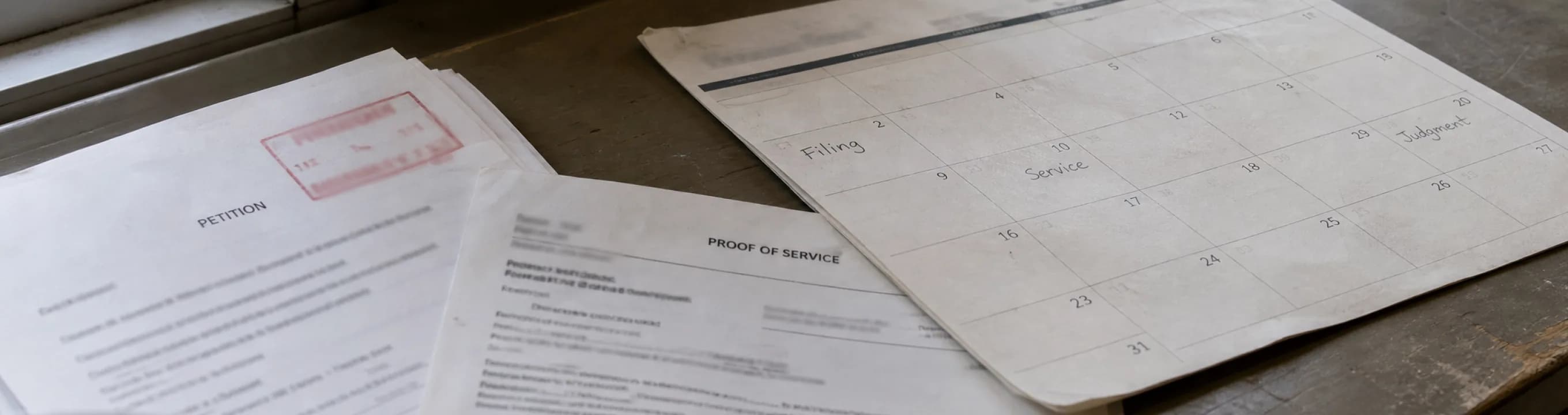
The summons packet has been delivered, but the court file still needs a record of who served it, where service happened, and which method was used. FL-115 records those facts after service in a California family-law, uniform-parentage, or custody-and-support case. The completed proof is filed with the court; it is not one of the papers delivered to the respondent.
The Judicial Council approved FL-115 for optional use. Service still must be proved, but this exact form is not the only acceptable way to do that. It is nonetheless the proof-of-service form courts expect in family cases. The current two-page edition is “FL-115 [Rev. January 1, 2021],” cites Code of Civil Procedure section 417.10 in its footer, and has been effective since January 1, 2021.
This page explains what the statewide form records. It is general information, not legal advice about whether a particular attempt at service was legally sufficient.
Who can complete FL-115?
Item 1 begins with the server's statement: at the time of service, the server was at least 18 years old and was not a party to the action. The person who served the papers supplies a name, address, and telephone number in item 4. The form also asks whether that person is exempt from registration, is not a registered California process server, or is a registered process server.
The server signs under penalty of perjury under California law. A California sheriff, marshal, or constable may instead certify that the statement is true and correct. Once the proof is complete, it is filed with the superior court handling the case; the court directory links to county court information.
Which papers does the form say were served?
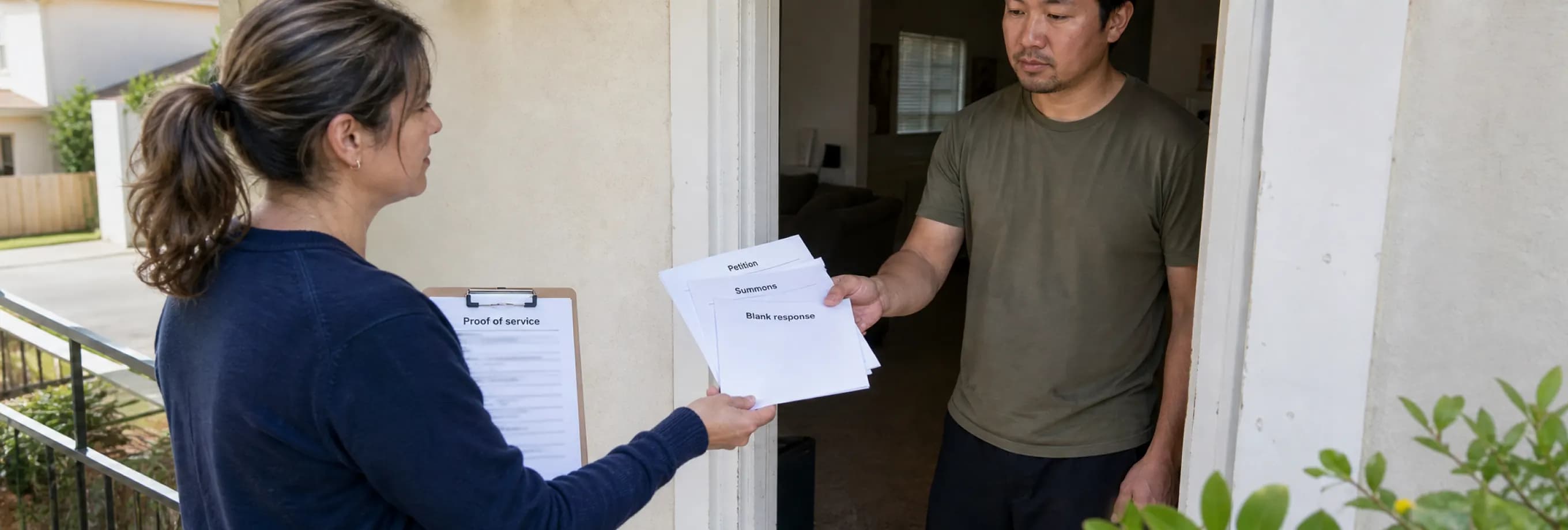
Item 1 first identifies one of three case-opening packets: Family Law: Petition—Marriage/Domestic Partnership, Summons, and blank Response—Marriage/Domestic Partnership; Uniform Parentage: Petition to Determine Parental Relationship, Summons, and blank Response to Petition to Determine Parental Relationship; or Custody and Support: Petition for Custody and Support of Minor Children, Summons, and blank Response to Petition for Custody and Support of Minor Children.
The form then provides checkboxes for these additional documents:
- Completed and blank Declaration Under Uniform Child Custody Jurisdiction and Enforcement Act (UCCJEA)
- Completed and blank Declaration of Disclosure
- Completed and blank Schedule of Assets and Debts
- Completed and blank Income and Expense Declaration
- Completed and blank Financial Statement (Simplified)
- Completed and blank Property Declaration
- Request for Order, and blank Responsive Declaration to Request for Order
- Other (specify)
The server marks what was actually delivered; the checklist does not say every listed document belongs in every packet.
Which service methods appear on FL-115?
The form offers four named methods. Personal service records personal delivery to the respondent under CCP section 415.10. Substituted service under CCP section 415.20 records papers left with an adult apparently in charge at the respondent's office or usual place of business, or with a competent adult household member at home. It also records the required later mailing by first-class mail, postage prepaid, and states that a declaration of diligence is attached.
Mail and acknowledgment service under CCP section 415.30 uses first-class mail with two copies of Notice and Acknowledgment of Receipt, form FL-117, and a postage-paid return envelope. The completed FL-117 is attached. For an address outside California, the form lists registered or certified mail with return receipt requested under CCP section 415.40 and calls for the signed receipt or other evidence of actual delivery; it also prints CCP section 417.20. An “Other” line allows the server to specify a code section.
What starts after service?
Service starts the respondent's 30-day period to file a response. In a dissolution case, the six-month minimum before a judgment can terminate marital status runs from service of the summons and petition or the respondent's appearance, whichever happens first. The six-month waiting-period guide explains why filing the petition alone does not start that period.
That makes the date and method on the finished FL-115 more than filing details. If the proof does not match what happened with the summons packet, reviewing that narrow service record is a defined task for counsel. AttorneyIndex is a directory; readers can browse family law attorneys in Los Angeles without the directory choosing or recommending one.
Common questions
- What is California form FL-115?
- FL-115 is the Judicial Council proof-of-service form for a summons in family law, uniform-parentage, and custody-and-support cases. The completed form is filed with the court to document service.
- Who may serve the papers listed on FL-115?
- The form states that the server must be at least 18 years old and not a party to the action.
- Is FL-115 mandatory?
- No. It is approved for optional use. Proof that service occurred is still required, but this exact form is not the only acceptable way to provide it. FL-115 is the form courts expect in family cases.
- Which mail service uses form FL-117?
- Mail and acknowledgment service under Code of Civil Procedure section 415.30 uses two copies of FL-117 and a postage-paid return envelope. The completed acknowledgment is attached to FL-115.
- Is FL-115 available in Spanish?
- California Courts provides the FL-115s Spanish translation for reference. The English FL-115 is filed with the court.
Sources
Checked on September 22, 2026. Where this page and a court’s own published material disagree, the court is authoritative.
- Judicial Council of California — Form FL-115 (opens in a new tab)
- California Courts Self-Help — Form FL-115 information (opens in a new tab)
- Code of Civil Procedure section 415.10 — personal service (opens in a new tab)
- Code of Civil Procedure section 415.20 — substituted service (opens in a new tab)
- Code of Civil Procedure section 415.30 — acknowledgment by mail (opens in a new tab)
- Code of Civil Procedure section 415.40 — service outside California (opens in a new tab)
- Code of Civil Procedure section 417.10 — proof of service (opens in a new tab)
- Code of Civil Procedure section 417.20 — proof of service outside California (opens in a new tab)