
- Official title
- Declaration of Disclosure
- Issued by
- Judicial Council of California
- Revision
- Rev. July 1, 2013
- Use
- Mandatory
- Official PDF
- FL-140 on www.courts.ca.gov
A disclosure packet is ready to go to the other spouse, but the cover page still asks whether it is preliminary or final. FL-140 is that cover sheet, not a standalone financial form. Its checkboxes identify the packet as the petitioner's or respondent's preliminary or final declaration of disclosure, and its numbered list records what is attached.
The current one-page form became effective July 1, 2013. Its footer reads “Form Adopted for Mandatory Use, FL-140 [Rev. July 1, 2013]” and cites Family Code sections 2102, 2104, 2105, 2106, and 2112. California Courts also provides a Spanish translation, fl140s.pdf, for reference. The self-help page describes FL-140 as the form used to list the financial documents given to a spouse as part of the first or final set.
This page explains the statewide cover sheet and the instructions printed on it. It is general information, not legal advice about how to characterize property, value an asset, or complete a disclosure in a particular case.
What documents are attached to FL-140?
The form's six numbered items make up the disclosure set:
- A completed FL-142, Schedule of Assets and Debts, or FL-160, Property Declaration, with the Community and Quasi-Community Property and Separate Property boxes specifying what FL-160 covers
- A completed FL-150, Income and Expense Declaration
- All tax returns filed by the party in the two years before the date the disclosure documents were served
- A statement of all material facts and information regarding valuation of all assets that are community property or in which the community has an interest
- A statement of all material facts and information regarding obligations for which the community is liable
- An accurate and complete written disclosure of any investment, business, or other income-producing opportunity presented since separation that results from an investment, significant business, or other income-producing opportunity from the date of marriage to the date of separation
The last three attachments are written statements, not Judicial Council forms. FL-140 ends with a declaration under penalty of perjury that the information on the cover sheet is true and correct.
Which disclosure paper does the court receive?
The instruction across the form is capitalized: “DO NOT FILE DECLARATIONS OF DISCLOSURE OR FINANCIAL ATTACHMENTS WITH THE COURT.” FL-140 and the listed financial documents are served on the other party. Neither the preliminary nor final disclosure is filed with the court.
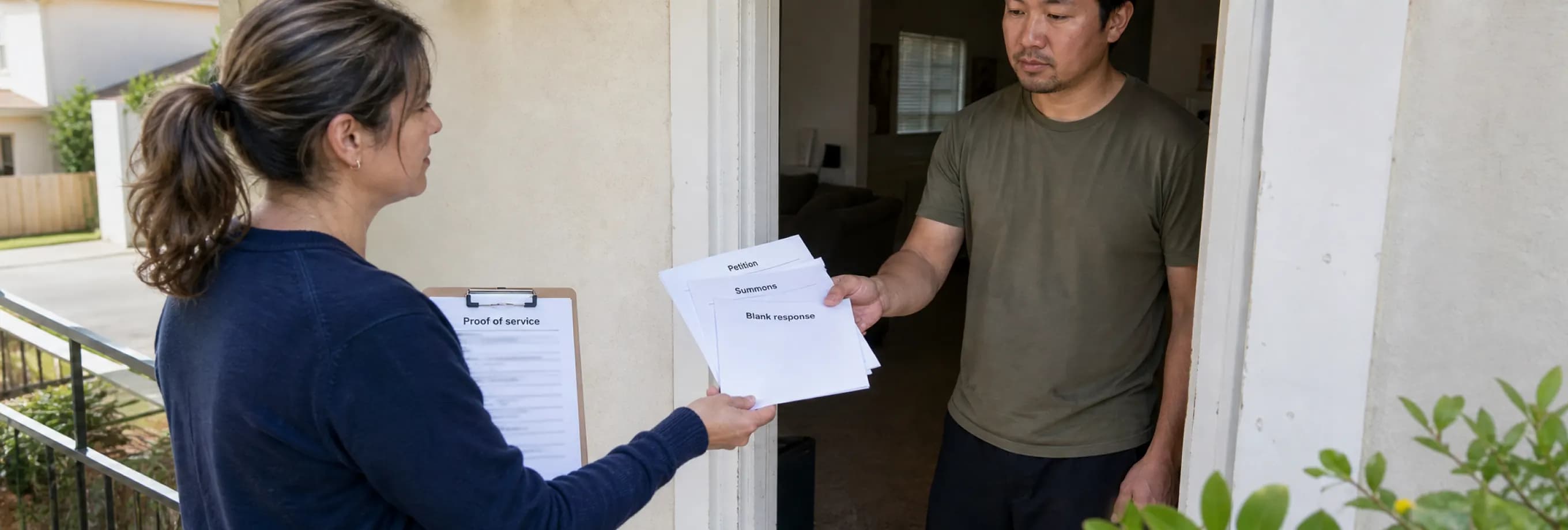
Instead, FL-141, Declaration Regarding Service of Declaration of Disclosure, is the paper filed to state that service was completed or waived. That distinction keeps the financial packet out of the court filing while giving the court a record of the disclosure step. The California divorce process guide places it within the larger case sequence.
When is the preliminary declaration served?
FL-140 says the petitioner must serve the preliminary declaration at the same time as the Petition or within 60 days of filing the Petition. The respondent must serve it at the same time as the Response or within 60 days of filing the Response. The form says those time periods may be extended by the parties' written agreement or by court order under Family Code section 2104(f).
Service of a preliminary declaration may not be waived by agreement. Final disclosure is treated differently: parties who agree to waive their final declarations must file their written agreement with the court on FL-144.
Do the same disclosure rounds apply in every case?
In a summary dissolution, each spouse or domestic partner exchanges preliminary disclosures as described in FL-810, Summary Dissolution Information. Final disclosures are not required under Family Code section 2109.
The form also identifies a default-judgment exception. When the default judgment is not stipulated and is not based on a marital settlement agreement, only the petitioner must complete and serve a preliminary declaration; neither party must serve a final disclosure (Family Code section 2110).
For the packet waiting to be served, a limited-scope review can be confined to the cover sheet, the financial forms, and whether the six listed attachments are present. AttorneyIndex is a directory; readers may browse family law attorneys in Los Angeles without the directory selecting or recommending one.
Common questions
- What is California form FL-140?
- FL-140 is the mandatory cover sheet identifying the financial documents served on the other party as a preliminary or final declaration of disclosure. It is not a standalone disclosure packet.
- Is FL-140 filed with the court?
- No. The form says not to file declarations of disclosure or financial attachments with the court. FL-141 is filed to state that service was completed or waived.
- When is the preliminary disclosure due?
- The petitioner serves it with the Petition or within 60 days of filing the Petition. The respondent serves it with the Response or within 60 days of filing the Response. Written agreement or court order may extend those periods.
- Can the parties waive disclosure?
- They may not waive preliminary declarations of disclosure by agreement. Parties who agree to waive final declarations must file their written agreement with the court on FL-144.
- Are final disclosures required in a summary dissolution?
- No. FL-140 says each spouse or domestic partner exchanges preliminary disclosures as described in FL-810, but final disclosures are not required in a summary dissolution.
Sources
Checked on September 22, 2026. Where this page and a court’s own published material disagree, the court is authoritative.
- Judicial Council of California — Form FL-140 (opens in a new tab)
- California Courts Self-Help — Form FL-140 information (opens in a new tab)
- Family Code section 2104 — preliminary declaration of disclosure (opens in a new tab)
- Family Code section 2105 — final declaration of disclosure (opens in a new tab)
- Family Code section 2109 — summary dissolution disclosure (opens in a new tab)
- Family Code section 2110 — disclosure in default cases (opens in a new tab)