
The saved calculation says $937.50. A second run uses the same incomes and parenting schedule, yet the result moves after one tax field changes. The equation did not change. One of its inputs did.
That is the useful way to read a California guideline result: as the product of stated assumptions, not as a number that appeared independently of them. Current Family Code section 4055 supplies the formula. Sections 4058 and 4059 define the income that goes into it, while parenting time supplies another variable. A result can be checked only when those inputs remain attached.
This guide provides general legal information. Its example illustrates the statutory arithmetic; it does not predict or recommend an amount for any family.
One equation, two calculations inside K
The current version of Family Code section 4055 was repealed and added by SB 343. It became effective January 1, 2024, and operative September 1, 2024. The statewide guideline is:
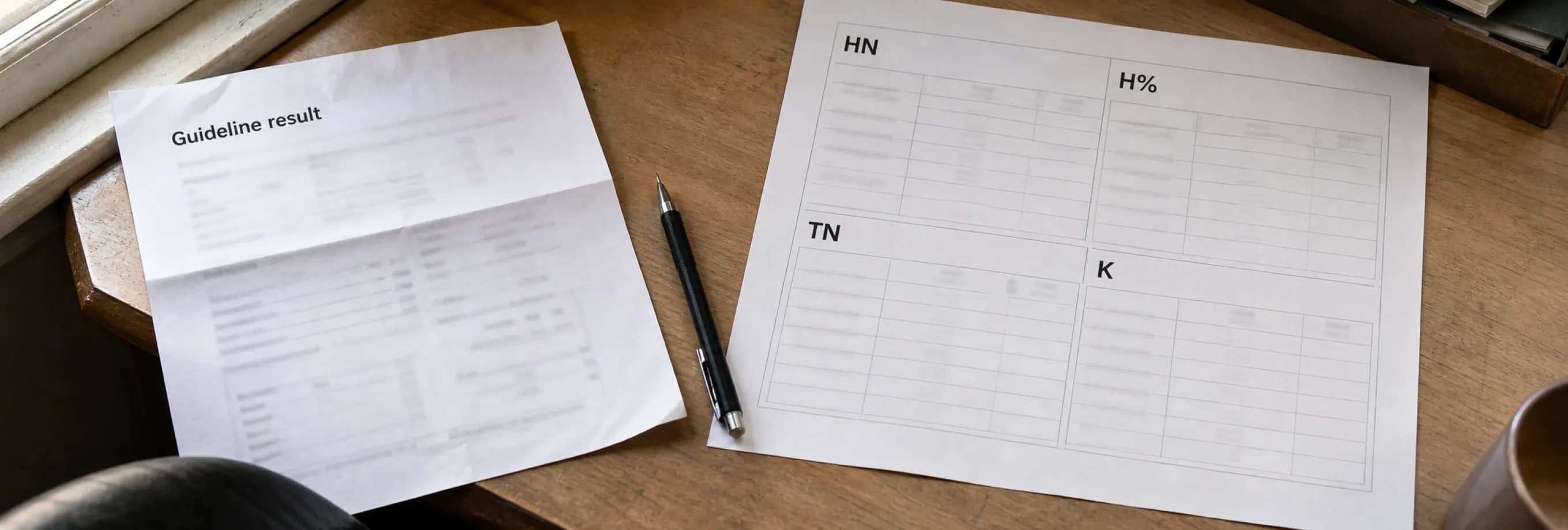
CS = K[HN - (H%)(TN)]
The statute defines CS as the child support amount. HN is the high earner's net monthly disposable income, H% is that parent's approximate percentage of primary physical responsibility for the children compared with the other parent, and TN is both parents' total net monthly disposable income. K is the amount of both parents' income allocated for child support under section 4055(b)(3).
K is not one fixed percentage. First, section 4055 selects an income fraction from the TN bracket:
| Total net disposable income per month | Income fraction |
|---|---|
| $0-$2,900 | 0.165 + TN/82,857 |
| $2,901-$5,000 | 0.131 + TN/42,149 |
| $5,001-$10,000 | 0.250 |
| $10,001-$15,000 | 0.10 + 1,499/TN |
| Over $15,000 | 0.12 + 1,200/TN |
That fraction is multiplied by 1 + H% when H% is at or below 50 percent, or by 2 - H% when H% is above 50 percent. The split matters: K changes with both the income bracket and which side of 50 percent contains the high earner's time share.
Here is the opening calculation, labeled only as an illustration. Assume one child, HN of $5,000, the other parent's net monthly disposable income of $3,000, TN of $8,000, and H% of 25 percent. The $5,001-$10,000 bracket makes the income fraction 0.250. Because H% is below 50 percent, K = (1 + 0.25) x 0.250 = 0.3125. The remaining expression is $5,000 - (0.25 x $8,000) = $3,000, so CS = 0.3125 x $3,000 = $937.50 before any applicable adjustment or add-on. This illustrative arithmetic does not forecast an order.
For more than one child, section 4055 multiplies CS rather than running the one-child formula independently for each child:
| Number of children | Multiplier | Number of children | Multiplier |
|---|---|---|---|
| 2 | 1.6 | 6 | 2.625 |
| 3 | 2 | 7 | 2.75 |
| 4 | 2.3 | 8 | 2.813 |
| 5 | 2.5 | 9 | 2.844 |
| 10 | 2.86 |
The multipliers produce a presumed amount like any other guideline result, and the presumption can be rebutted. Section 4057(b)(3) names the case that matters most at the top of the income range: where the paying parent has an extraordinarily high income and the formula amount would exceed the children's needs.
Section 4055 also creates a rebuttable presumption for a low-income adjustment when the obligor's net disposable income falls below the monthly gross income from full-time work at California's minimum wage. The statute ties the threshold to the wage rather than placing one permanent dollar amount in the article. Rebuttable cuts both ways: qualifying on income does not make the adjustment automatic, and the other parent can put evidence against it.
Gross income is the start; net disposable income is the formula input
Section 4058 starts broadly with annual gross income from whatever source derived, subject to its stated exclusions. Its examples include wages, commissions, bonuses, rents, dividends, pensions, unemployment benefits, and business income. For a proprietorship, the statute uses gross receipts reduced by expenditures required to operate the business. A court may also consider employee or self-employment benefits in its discretion, including whether a benefit reduces living expenses.
Net disposable income comes next. Section 4059 requires specified deductions from annual gross income. For taxes, the calculation uses liability that accurately reflects filing status, dependents, exclusions, deductions, and credits. Current paycheck withholding is not automatically the same number. Other listed deductions include FICA, mandatory union dues and retirement contributions, qualifying health premiums, certain support actually paid, court-allowed job expenses, and statutory hardship deductions.
That distinction explains why a tax field can move the opening result without changing either parent's paycheck. It also explains why an unlabeled entry called “monthly income” is inadequate: the formula needs to distinguish gross income from net monthly disposable income.
Judicial Council form FL-150, the Income and Expense Declaration, asks for employment, tax, income, deduction, asset, and expense information. The form directs the filer to attach pay stubs for the last two months with Social Security numbers blacked out. Those records do not answer every disputed income question, but they give each entered figure a source and date.
Earning capacity has its own mandatory-permissive divide under the current section 4058. When a parent's annual gross income is unknown, the court shall consider earning capacity. When annual gross income is known, the court may, in its discretion, consider earning capacity instead of income, consistently with the children's best interests and the statutory factors. Treating both situations as optional would misstate the current law. This is what other sources call imputed income: the court uses what a parent could earn instead of what they report earning.
H% describes responsibility for the children
H% is not defined as an overnight count, and where domestic violence is in the case the custody question behind it has its own presumption. Section 4055 calls it the high earner's approximate percentage of time having primary physical responsibility for the children compared with the other parent. If the parents have different time-sharing arrangements for different children, the statute uses the average of those percentages.
A calendar can still make the input visible. It can identify the repeating school-week pattern and separate holidays or vacations that replace ordinary days. That is also why a calculator asks for a timeshare percentage: the share of time with each parent is the practical stand-in for the statutory measure, not a separate legal test. The legal definition remains primary physical responsibility, and Judicial Council form FL-342 records each parent's approximate percentage of time among the information used to determine support.

Documentation matters more than false precision. A percentage should carry enough schedule information that another person can understand what the number represents.
The base formula does not finish the order
The section 4055 amount is presumed correct under Family Code section 4057. That presumption may be rebutted with admissible evidence showing that applying the formula would be unjust or inappropriate because a listed factor applies. For a non-guideline order, section 4056 says the court shall state the guideline amount, the reason for the difference, and why the different amount is consistent with the children's best interests.
Additional support is separate from that base amount. Section 4062 says the court shall order childcare costs actually incurred for employment or reasonably necessary education or training for employment skills, unless those costs are specifically included in the guideline calculation. It also shall order reasonable uninsured health care costs for the children. The court may order costs related to educational or other special needs and travel expenses for visitation. Those verbs mark different legal rules: childcare and uninsured health care are mandatory add-ons a parent can insist on, while special-needs costs and visitation travel are discretionary and have to be argued for.
Parents may stipulate to another amount subject to court approval. For a below-guideline agreement, section 4065 says the court shall not approve unless the parties make the required declarations, including that they are informed of their child-support rights, are free from coercion or duress, and will adequately meet the children's needs. If a local child support agency is providing services, it must join the stipulation by signing it.
Keep the assumptions with the result
California Child Support Services publishes an online guideline calculator built on the same statutory formula the courts use. It says plainly what it is: an estimate, not a guarantee, with the county child support commissioner or family law judge holding final authority over the amount ordered.
Certification is worth understanding, because it is the reason a calculator can be trusted and the reason a result can go stale. The Judicial Council certifies guideline calculators annually, and a mid-year change in tax law can pull a calculator out of certification until it is updated — that happened after the federal tax changes of July 2025. As of this page's August 15, 2026 review the Judicial Council lists the state calculator, along with the commercial ones, as recertified for 2026-27, with current certifications set to expire on March 31, 2027. The practical lesson is not about any one outage: a result produced by an out-of-date tool can be wrong on taxes alone, so it is worth confirming that the calculator being used is currently certified.
California Courts likewise says every county offers free family law facilitator help with guideline calculations, forms, and court-process information. That official resource is the sound place to check whether a changed calculator input explains a changed result.
For any calculation, keep one packet containing the income period used, gross-income records, section 4059 deductions, tax filing assumptions, the schedule supporting each time percentage, the number of children, and any claimed adjustment or add-on. Save the calculator output with that packet. The total alone cannot show which line moved.
A limited-scope legal review can also be framed around the same bounded task: identify which inputs are agreed, which are disputed, and which lack records, then explain the governing rule for each dispute. AttorneyIndex is a directory, not a matching or referral service. Readers can browse California family law attorneys by location, review individual listings and linked State Bar information, and contact an attorney directly; the directory does not select or recommend one.
Return to the two results from the opening. The useful question is not which total looks more plausible. It is which input changed, what authority governs it, and what record supports it.
The formula is public and the inputs are where cases turn. Of the 3,726 family-law attorneys listed in this directory across 157 cities, 635 are State Bar certified specialists in Family Law.
Common questions
- What formula does California currently use for child support?
- Family Code section 4055 uses CS = K[HN - (H%)(TN)]. The current version has been operative since September 1, 2024.
- What does K mean in the California child support formula?
- K is the amount of both parents' income allocated for child support. Its calculation uses the parents' total net monthly disposable income and a time factor that changes when the high earner's H% is above 50 percent.
- Does parenting time affect California guideline child support?
- Yes. H% is the high earner's approximate percentage of primary physical responsibility for the children compared with the other parent. If the schedules differ by child, section 4055 uses the average percentage.
- Is the state guideline calculator certified, and what does that mean?
- The Judicial Council certifies guideline calculators annually. As reviewed August 15, 2026, the state calculator is listed as recertified for 2026-27, with certifications set to expire March 31, 2027. Certification is why a result can be relied on as an estimate; it is never a guarantee, and the commissioner or judge sets the ordered amount.
- Can parents agree to a child support amount outside the guideline?
- They may stipulate to a different amount subject to court approval. Family Code section 4065 sets declarations required before a court may approve a below-guideline agreement, and an LCSA must join when it provides services.
Sources
Checked on August 16, 2026. Where this page and a court’s own published material disagree, the court is authoritative.
- Family Code section 4055 — current statewide guideline formula (opens in a new tab)
- Family Code section 4056 — findings supporting guideline and non-guideline orders (opens in a new tab)
- Family Code section 4057 — guideline presumption and rebuttal factors (opens in a new tab)
- Family Code section 4058 — gross income and earning capacity (opens in a new tab)
- Family Code section 4059 — net disposable income deductions (opens in a new tab)
- Family Code section 4062 — mandatory and discretionary add-ons (opens in a new tab)
- Family Code section 4065 — stipulated child support (opens in a new tab)
- Judicial Council form FL-150 — Income and Expense Declaration (opens in a new tab)
- Judicial Council form FL-342 — Child Support Information and Order Attachment (opens in a new tab)
- California Child Support Services — Guideline Calculator (opens in a new tab)
- Judicial Council of California — certified guideline support calculators (opens in a new tab)
- California Courts — Child support and free facilitator help (opens in a new tab)