
- Official title
- Declaration Regarding Service of Declaration of Disclosure and Income and Expense Declaration
- Issued by
- Judicial Council of California
- Revision
- Rev. July 1, 2013
- Use
- Mandatory
- Official PDF
- FL-141 on www.courts.ca.gov
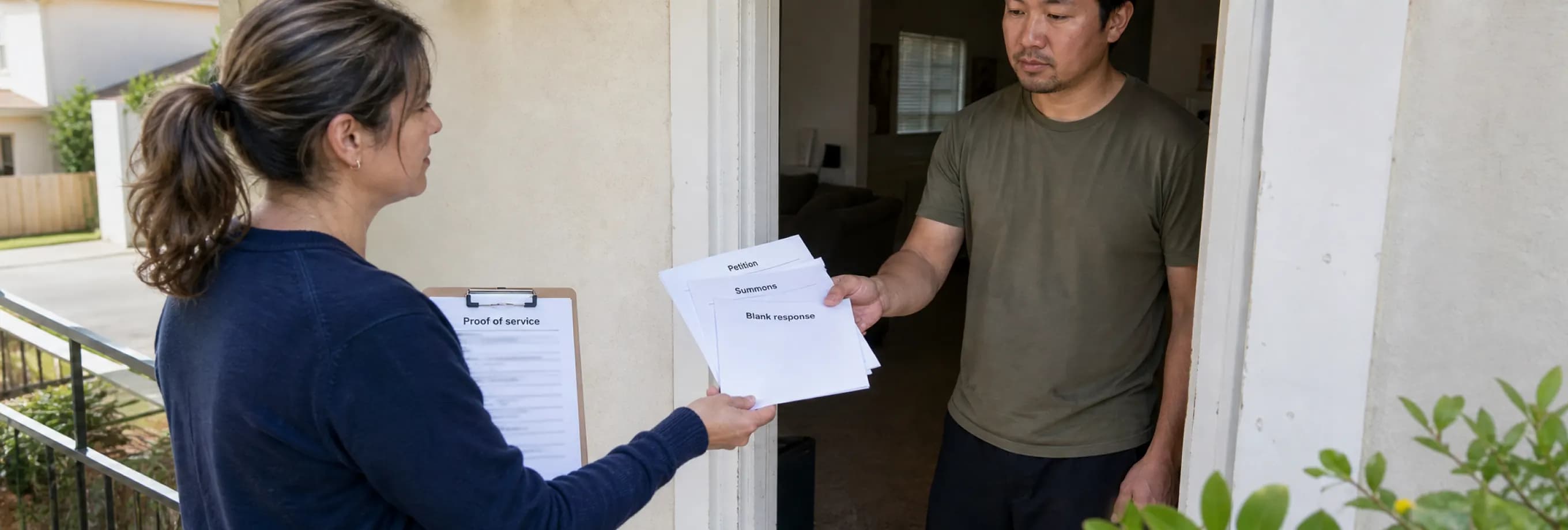
The judgment papers are assembled, but the court file still needs proof that the financial disclosures moved between the parties. FL-141 is the one disclosure paper filed with the court. It tells the court whether preliminary or final disclosures were served, whose disclosures they were, who received them, the service date, and the method used.
The disclosure documents themselves travel to the other party, not into the court file. FL-141's note says not to file the preliminary or final Declaration of Disclosure, or any attachments to either declaration, with this form. The current one-page edition is “FL-141 [Rev. July 1, 2013]” and has been effective since July 1, 2013.
This page explains what the statewide form records and what the cited statutes say. It is general information, not legal advice about whether disclosure in a particular case is complete.
What does FL-141 say was served?
The signer first identifies whether they are the attorney for the petitioner or respondent, or are the petitioner or respondent. For a preliminary disclosure, item 2 lists FL-140, a current FL-150, a completed FL-142 or FL-160 with appropriate attachments, all tax returns the party filed in the two years before service, and the other information required by Family Code section 2104.
For a final disclosure, item 3 lists FL-140, a current FL-150, a completed FL-142 or FL-160 with attachments, and the material facts and information required by Family Code section 2105. The form defines “current” as completed within the past three months, provided no facts have changed.
Each item has checkboxes for the petitioner's or respondent's set. The recipient may be the other party or the other party's attorney. The available methods are personal service, mail, and Other, with space to specify another method; the form also records the date of service.
What waiver options appear on the form?
Item 4 can identify the petitioner's or respondent's preliminary or final declaration of disclosure and current Income and Expense Declaration, then state how service was waived. Its first option says the parties agreed to waive final-declaration requirements under Family Code section 2105(d). FL-144 may be used, and FL-141 records whether the waiver was filed on a stated date or is being filed at the same time.
The second option applies when a party failed to comply and the court granted a request for voluntary waiver of receipt under section 2107; the date of that order is entered. The third is for a default proceeding without a stipulated judgment or settlement agreement, where the petitioner waives final-disclosure requirements under section 2110. These are separate checkboxes, not a general permission to skip disclosure.
Why does FL-141 matter to the judgment package?
Family Code section 2106 says that, subject to its listed exceptions, judgment may not be entered with respect to the parties' property rights unless each party or that party's attorney has executed and served the final Declaration of Disclosure and current Income and Expense Declaration. The section also requires each party or attorney to file a declaration under penalty of perjury stating that service occurred, or that final disclosure was waived under section 2105(d) or 2110.
For a judgment involving property rights, a package without FL-141 therefore lacks the filed declaration section 2106 calls for. The statute's exceptions matter: section 2107 addresses a court-granted voluntary waiver of receipt after noncompliance, while section 2110 addresses the petitioner's final-disclosure waiver in a qualifying default judgment.
Where does FL-141 go?
The form's instruction is direct: “File this document with the court.” The statewide court directory leads to county filing information. The financial disclosures and their attachments are not filed with it.
If the judgment packet and the actual service history do not match, a limited review can focus on the disclosure set, the dates, and the waiver record. AttorneyIndex is a directory; readers can browse family law attorneys in Los Angeles without the directory selecting or recommending one.
Common questions
- What is California form FL-141?
- FL-141 is the mandatory declaration filed with the court to report service of preliminary or final disclosure documents and an Income and Expense Declaration, or to report a waiver listed on the form.
- Are the disclosure documents attached to FL-141?
- No. FL-141 says to file the declaration with the court and not to file a copy of the preliminary or final Declaration of Disclosure or any attachments with it.
- Which service methods can be marked on FL-141?
- For both preliminary and final disclosures, FL-141 provides checkboxes for personal service, mail, or “Other,” with space to specify the other method.
- Can the final declaration of disclosure be waived?
- The form includes a mutual-waiver option under Family Code section 2105(d) and says FL-144 may be used. It also lists court-granted voluntary waiver of receipt under section 2107 and a default-proceeding waiver under section 2110.
- Is FL-141 available in Spanish?
- California Courts provides FL-141S, fl141s.pdf, as a Spanish translation for reference. The English FL-141 is filed with the court.
Sources
Checked on September 22, 2026. Where this page and a court’s own published material disagree, the court is authoritative.
- Judicial Council of California — Form FL-141 (opens in a new tab)
- California Courts Self-Help — Form FL-141 information (opens in a new tab)
- Family Code section 2104 — preliminary declaration of disclosure (opens in a new tab)
- Family Code section 2105 — final declaration and mutual waiver (opens in a new tab)
- Family Code section 2106 — disclosure required before judgment (opens in a new tab)
- Family Code section 2107 — noncompliance and voluntary waiver of receipt (opens in a new tab)
- Family Code section 2110 — default judgment exception (opens in a new tab)