
- Official title
- Request to Waive Court Fees
- Issued by
- Judicial Council of California
- Revision
- Rev. March 1, 2026
- Use
- Mandatory
- Official PDF
- FW-001 on www.courts.ca.gov
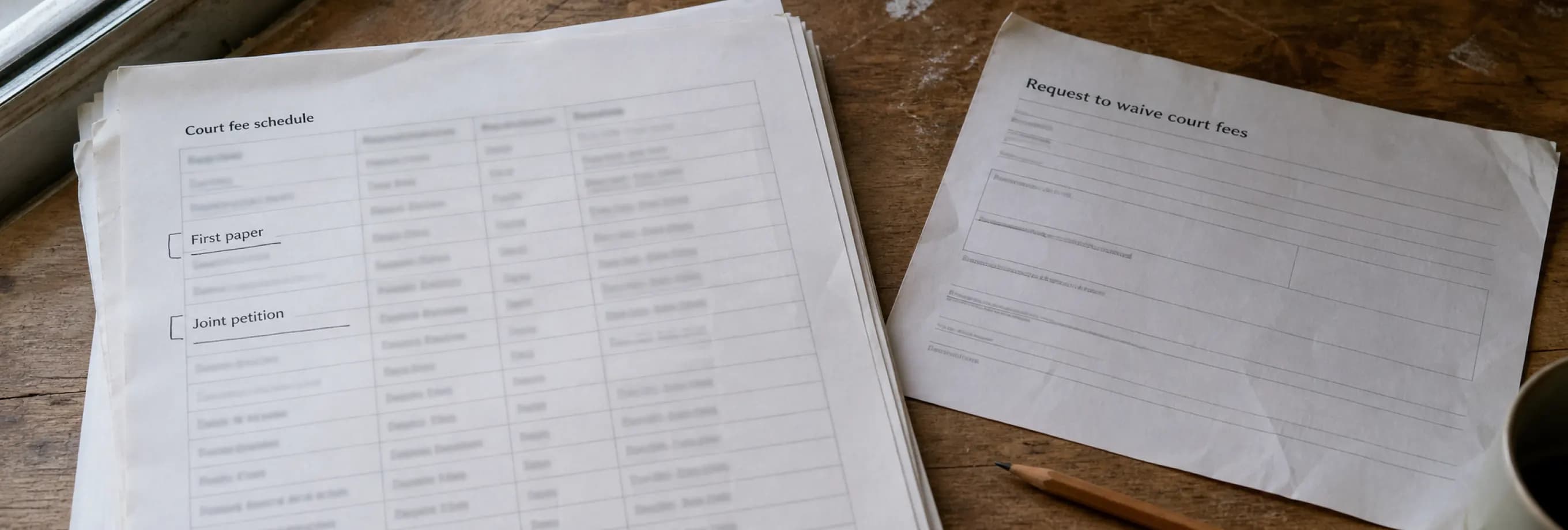
A California family-law case is ready to begin, but paying the court fees would take money needed for the household. FW-001 asks the court to waive filing fees and court costs for a person who receives listed public benefits, meets the form's household-income test, or does not have enough income for basic needs and court fees. The FL-100 petition is the opening form for the one-party divorce process; divorce with no money in California places FW-001 in that larger context.
This revision is very recent: it became effective March 1, 2026. A reader who downloaded an older FW-001 elsewhere may have an out-of-date copy. The current form is two pages and mandatory. Its footer reads “Judicial Council of California, courts.ca.gov, Rev. March 1, 2026, Mandatory Form, Gov. Code, § 68633; Cal. Rules of Court, rules 3.51, 8.26, and 8.818.” California Courts provides Chinese Simplified, Korean, Spanish, and Vietnamese translations.
This page explains the statewide fee-waiver request and the questions printed on it. It is general information, not legal advice about eligibility, what financial details to report, or whether the court will grant a request.
Which three grounds does FW-001 list?
Item 5 gives three grounds. The first is receiving one or more of the public benefits named on the form: Food Stamps, CalWORKS or Tribal TANF, Supp. Sec. Inc., SSP, County Relief/Gen. Assist., Medi-Cal, WIC, CAPI, Unemployment, or IHSS.
The second uses this income language: “My gross monthly household income (before deductions for taxes) is less than the amount listed below.” The form then prints monthly income amounts by family size. The third says: “I do not have enough income to pay for my household's basic needs and the court fees.” Under that ground, the person asks the court to waive all fees and costs, waive some of them, or allow payments over time.
The selection controls how much of page 2 is completed. A person who checks the public-benefits ground does not fill out the page. The household-income ground requires questions 7, 8, and 9. The basic-needs ground requires the entire page.
What financial information does page 2 request?
Question 7 asks whether income changes a lot from month to month; if so, the form uses average income for the past 12 months. Question 8 asks for each source and amount of gross monthly income. Question 9 asks about the income of other people in the home who depend in whole or in part on the applicant for support, or on whom the applicant depends in whole or in part.
Question 10 covers money and property: cash, financial accounts, vehicles, real estate, and other personal property, together with value and amounts still owed where the form requests them. Question 11 covers payroll deductions and monthly expenses, including housing, food, utilities, clothing, medical and dental costs, child care, transportation, insurance, support, installment payments, court-ordered withholding, and other expenses.
FW-001 is marked “CONFIDENTIAL.” At the end of page 2, it directs the user, for protection and privacy, to press the Clear button after printing the form.
What happens after the court receives the request?
For a superior-court request, the court's decision is delivered on FW-003, the order on the fee-waiver request. FW-001 also says the court may order the applicant to answer questions about finances.
Even after a waiver, the form says payment may still be required later if the applicant cannot give the court proof of eligibility, the applicant's financial situation improves during the case, or a civil case settles for $10,000 or more. For that settlement, the form says the trial court has a lien in the amount of the waived fees and costs and may charge collection costs. It also directs a person whose financial situation or ability to pay improves to notify the court within five days on FW-010.
For someone preparing the request with the opening case papers, a limited-scope consultation can focus on which printed ground applies and whether the required sections are complete. AttorneyIndex is a directory; readers may browse family law attorneys in Los Angeles without the directory selecting or recommending one.
Common questions
- What is California form FW-001?
- FW-001 is the mandatory Request to Waive Court Fees. It asks the court to waive fees and costs for a person receiving listed public benefits, meeting the printed household-income test, or lacking enough income for basic needs and court fees.
- Which public benefits does FW-001 list?
- The form lists Food Stamps, CalWORKS or Tribal TANF, Supp. Sec. Inc., SSP, County Relief/Gen. Assist., Medi-Cal, WIC, CAPI, Unemployment, and IHSS.
- What financial information does FW-001 request?
- Depending on the ground selected, page 2 asks about gross monthly income, household income, money and property, and monthly deductions and expenses.
- Is the information on FW-001 confidential?
- The form is marked “CONFIDENTIAL.” It also directs the user, for protection and privacy, to press the Clear button after printing the form.
- How recent is the current FW-001?
- The current two-page mandatory form became effective March 1, 2026. California Courts provides Chinese Simplified, Korean, Spanish, and Vietnamese translations.
Sources
Checked on September 22, 2026. Where this page and a court’s own published material disagree, the court is authoritative.