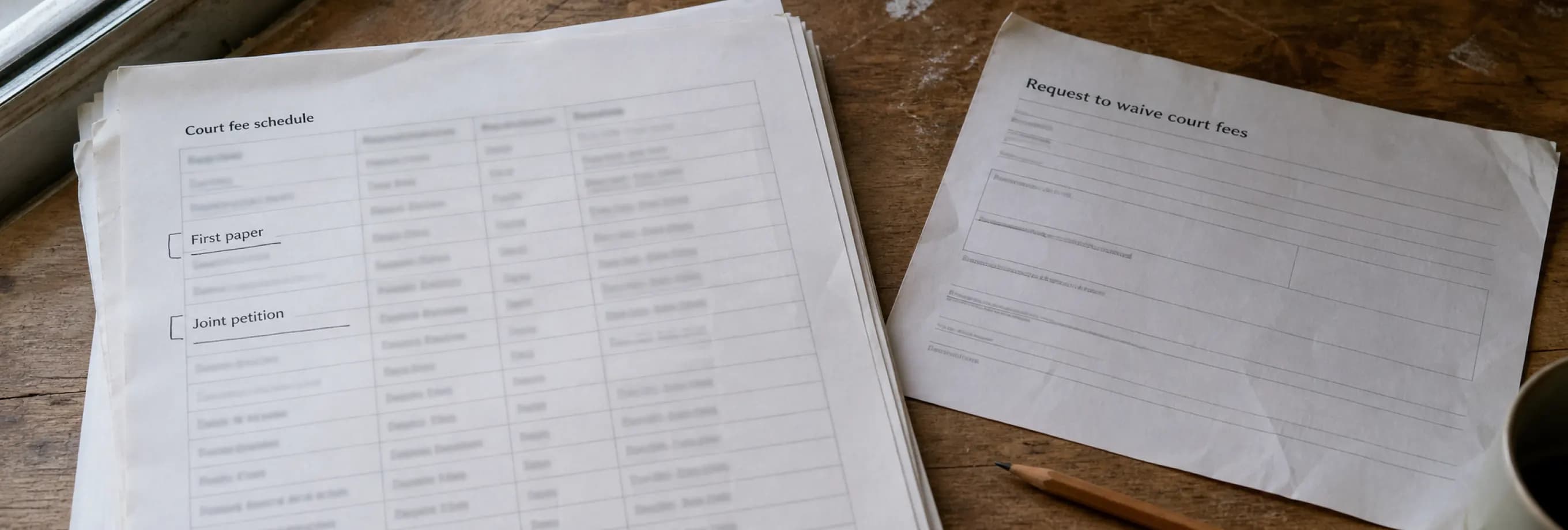

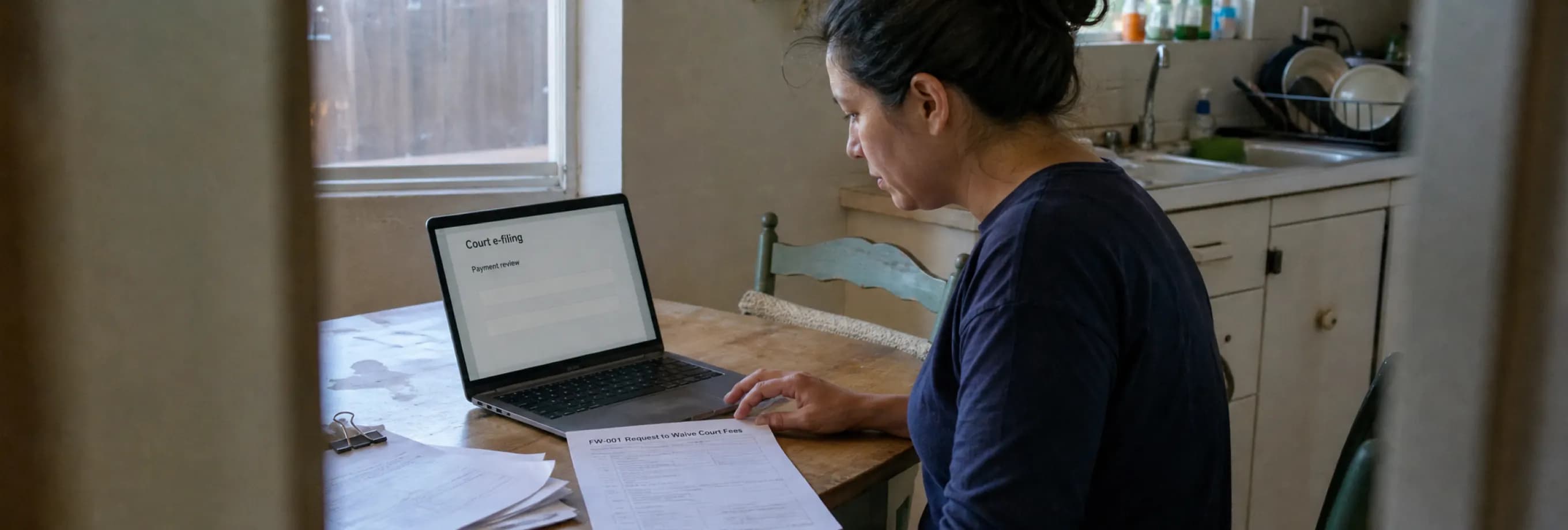
The filing portal reaches its payment screen, but the account will not cover the charge. That does not give the other spouse control over whether a California divorce can begin. A person who meets the financial rules can submit Request to Waive Court Fees (form FW-001) with the divorce papers instead of waiting to save the filing fee.
The waiver solves a court-cost problem. Free court services can help with procedure, a limited-scope lawyer can take on a defined piece of work, and Family Code section 2030 may address unequal access to attorney fees. Those are separate tools with separate limits.
This guide gives general information about California procedure, not advice for an individual case. Services and local charges vary by superior court.
Start with the fee the court is actually charging
California's 2026 statewide fee schedule sets the first-paper fee for a dissolution case at $435. The asterisk on that schedule matters: Riverside, San Bernardino, and San Francisco counties add local courthouse-construction surcharges, so the exact total comes from the county court's current fee schedule.
A joint petition for divorce is a separate line on the same schedule at $870 before any applicable local surcharges, under Family Code section 2342.5(h). The schedule describes it as one fee covering the appearance of both petitioners, and it adds a detail worth knowing in advance: if a petitioner later revokes the joint petition, no additional first-appearance fee is required from either person. The joint route is therefore not a half-price filing — with one exception on the same page. A joint petition for summary dissolution is listed at $435, the same as an ordinary first paper.
Each petitioner seeking a waiver submits a separate request. California Courts tells filers to ask the clerk how that court handles the fee when only one petitioner qualifies — one waiver does not automatically clear the joint fee.
FW-001 offers three grounds for an initial waiver:
- receipt of a qualifying public benefit named on the current form — Medi-Cal, CalFresh, SSI, CalWORKs, WIC and unemployment compensation are among them;
- gross monthly household income below the form's current limit for that household size; or
- inability to pay court fees while also paying for the household's basic needs.
The current mandatory FW-001 took effect March 1, 2026. Its income table changes with the federal poverty guidelines, so an older saved copy is not a reliable eligibility screen.
A waiver covers court costs, not the whole divorce
What a waiver covers is what the court's order says it covers, and that can include the fee to file or respond, fees for requests for orders, some court copies, sheriff's service, and other listed court costs. It does not pay a private lawyer or every outside expense. California Courts gives one specific example: a court reporter's written transcript is not covered.
Filing the request is not the same as receiving the waiver: the court decides, and until it does, the fee is deferred rather than forgiven. A waiver can be requested with the petition, with a response, or later if finances change, and it stays open to review afterwards. FW-001 warns that waived amounts may become payable if eligibility cannot be shown or if the person's finances improve during the case, and the recipient is expected to report a change. The order, form FW-003, shows what the court actually waived; it is more useful than assuming that every case-related bill disappeared.
Court staff can explain the route, but they are not counsel
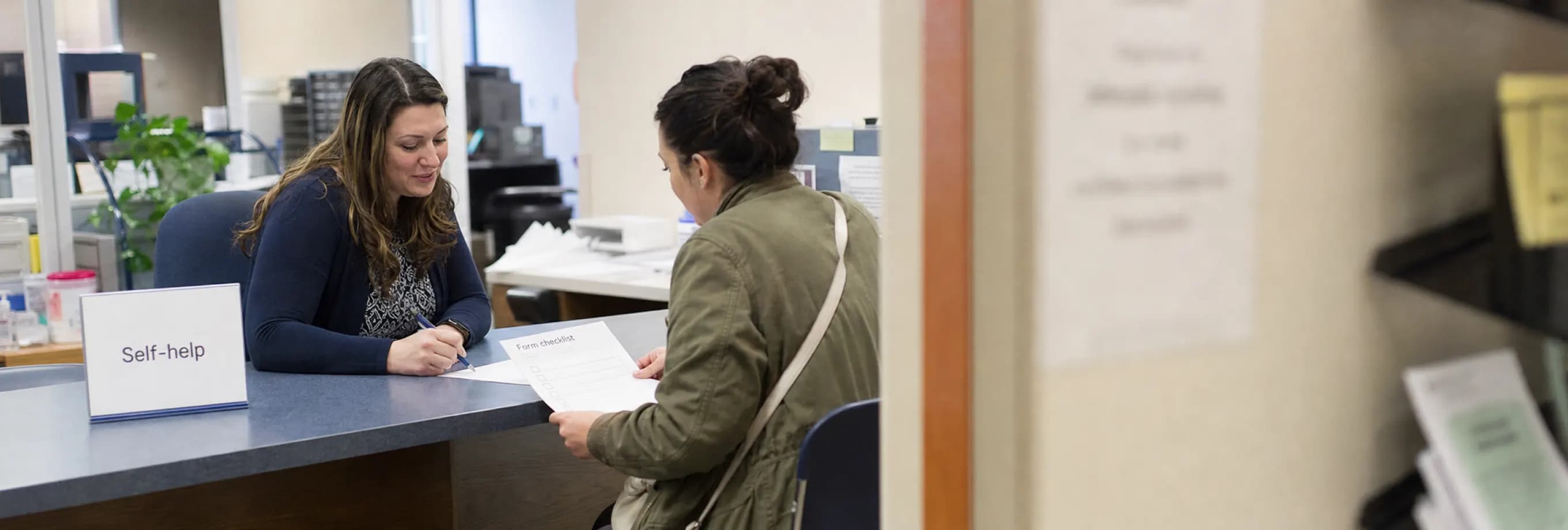
California Courts states that every superior court in the state has free legal help available in family law, and there is no income test for it. What that help looks like is a county matter: staff may explain procedure, identify forms, help with completing them, and describe the services that particular court runs, but hours, staffing and scope vary. Family law facilitators commonly work on child and spousal support and may cover other family-law subjects depending on the court.
The boundary is equally concrete. A self-help lawyer is not the filer's lawyer, the conversation does not carry attorney-client privilege, and both sides may use the same program. Staff can explain how a court process works; they cannot represent someone at a hearing or decide which settlement terms that person should accept.
Unequal access to lawyer money is a different request
No money in one spouse's checking account does not establish that there is no money available for legal work. Family Code section 2030 requires the court, when attorney fees are requested, to make findings about whether access to funds is unequal and whether one party can pay for both parties' legal representation. If the findings show both disparity and ability to pay, the statute directs the court to make a fee order. Section 2032 requires the award and its amount to be just and reasonable under the parties' relative circumstances.
This request is not part of FW-001, and it is not automatic. California Rules of Court, rule 5.427 requires Request for Order (FL-300), Request for Attorney's Fees and Costs Attachment (FL-319) or a comparable declaration, a current Income and Expense Declaration (FL-150), and a supporting declaration using FL-158 or comparable information. California Courts' filing instructions also direct divorce filers to complete FL-157, the Spousal or Domestic Partner Support Declaration Attachment, even when spousal support is not being requested. The court needs information about the work, fees already incurred or expected, and why the requested amount is reasonable.
“If the findings demonstrate disparity in access and ability to pay, the court shall make an order awarding attorney’s fees and costs.”
— Family Code section 2030(a)(2)
Saving on filing does not reduce the disclosure work
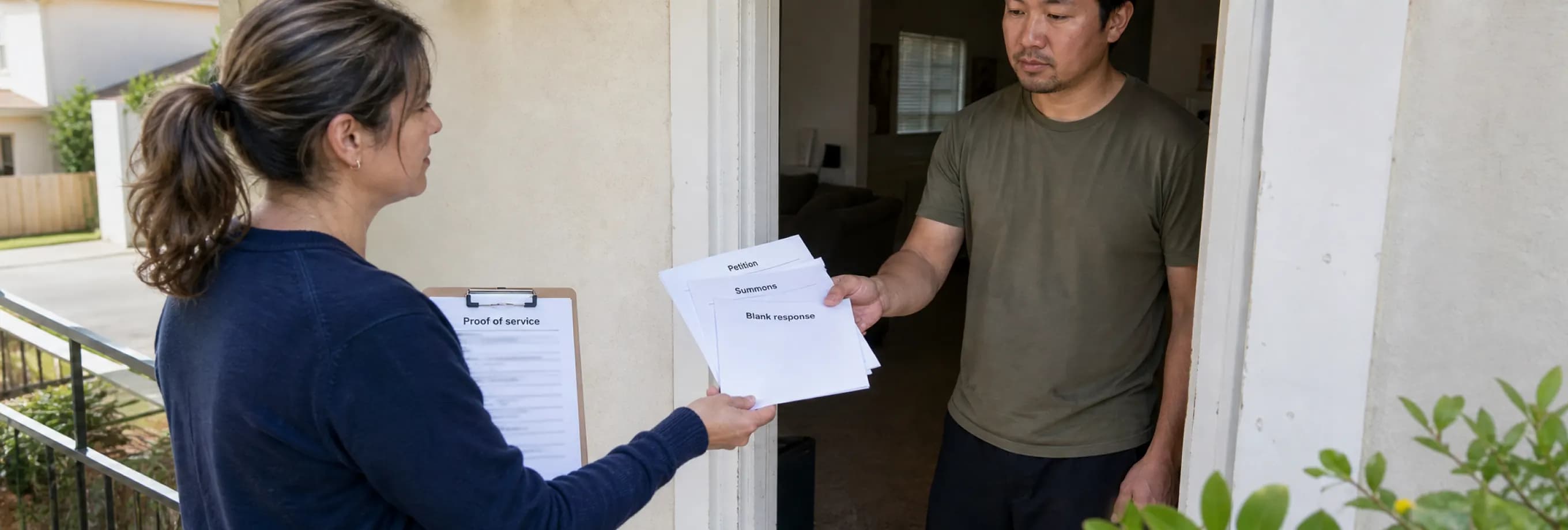
California's financial-disclosure duties remain in place after a fee waiver. Under Family Code section 2104, the petitioner generally serves a preliminary declaration with the petition or within 60 days after filing; a respondent who files a response generally has 60 days after that filing. The disclosure identifies assets and liabilities and includes an income and expense declaration. The disclosure documents go to the other party, while proof of service goes to the court.
Final declarations are a separate stage. Section 2105 allows spouses to waive that final exchange, but only through a mutual stipulation containing the statutory representations, including that the preliminary declarations were exchanged and the continuing disclosure obligations were fulfilled. Form FL-144 records that waiver. It does not excuse an omitted account, debt, or material valuation fact.
Limited-scope representation is another available model: a lawyer handles an agreed part of the case while the client handles the rest. The assignment can be described before money is spent, such as reviewing the disclosure packet, checking proposed property terms, or preparing documents for one hearing. The arrangement is voluntary on both sides — no lawyer is obliged to take a particular slice of a case. Whether a lawyer will accept that scope and what it will cost are not set by statewide law.
AttorneyIndex is a directory, not a law firm or referral service. Its county pages list California family-law attorneys, link to State Bar records, and show certified-specialist status where that information is available. At the payment screen, FW-001 is the document that addresses the immediate court-fee barrier. A lawyer search is a separate decision tied to a task that requires legal judgment.
Cost is not only the fee. Of the 5,012 active California attorneys in this directory, 1,495 list Spanish among the languages on their registry record. That is a floor rather than a share, because most records name no language at all, and it reports what was filed, not fluency or availability for a consultation.
Common questions
- What if I cannot afford California's divorce filing fee?
- A person who receives a listed public benefit, falls below the income table on form FW-001, or cannot pay court fees while meeting basic household needs may request a fee waiver. The court decides the request.
- What costs can a California fee waiver cover in a divorce?
- Depending on the order, it may cover filing and response fees, fees for requests for orders, certain copies, sheriff's service, and other court costs the order lists. It does not cover every expense; for example, it does not pay for a written court-reporter transcript or a private lawyer.
- Is free divorce help available without hiring a lawyer?
- California Courts says every superior court in the state has free family-law legal help, though scope and hours vary by county. Staff can provide legal information, explain forms and procedure, and offer the services available in that county, but they do not represent either side.
- Can the court make one spouse contribute to the other's attorney fees?
- Family Code section 2030 provides for need-based fee orders when the required findings show unequal access to funds and an ability to pay. A request requires financial and fee information, and the court determines the amount.
Sources
Checked on August 16, 2026. Where this page and a court’s own published material disagree, the court is authoritative.
- California Courts — 2026 Statewide Civil Fee Schedule (opens in a new tab)
- California Courts — Request to Waive Court Fees (FW-001) (opens in a new tab)
- California Courts — Ask for a fee waiver (opens in a new tab)
- California Courts — Court-based self-help services (opens in a new tab)
- California Courts — Limited-scope representation (opens in a new tab)
- Family Code section 2030 — access to legal representation (opens in a new tab)
- Family Code section 2032 — relative circumstances (opens in a new tab)
- California Rules of Court, rule 5.427 — attorney-fee requests (opens in a new tab)
- California Courts — Ask for money to hire a lawyer (opens in a new tab)
- Family Code section 2104 — preliminary disclosures (opens in a new tab)
- Family Code section 2105 — final disclosures and waiver (opens in a new tab)