
The cost of a California divorce comes in two parts that behave completely differently. One is set by the court, published, and identical for everyone in the county. The other depends on how much the two people disagree about — and that part has no ceiling anyone can quote in advance.
Knowing which is which is most of the answer. The court's half can be looked up today, in a published fee schedule, and planned around. The other half is time billed by professionals, and the way to control it is to reduce the number of things left to decide.
What the court charges
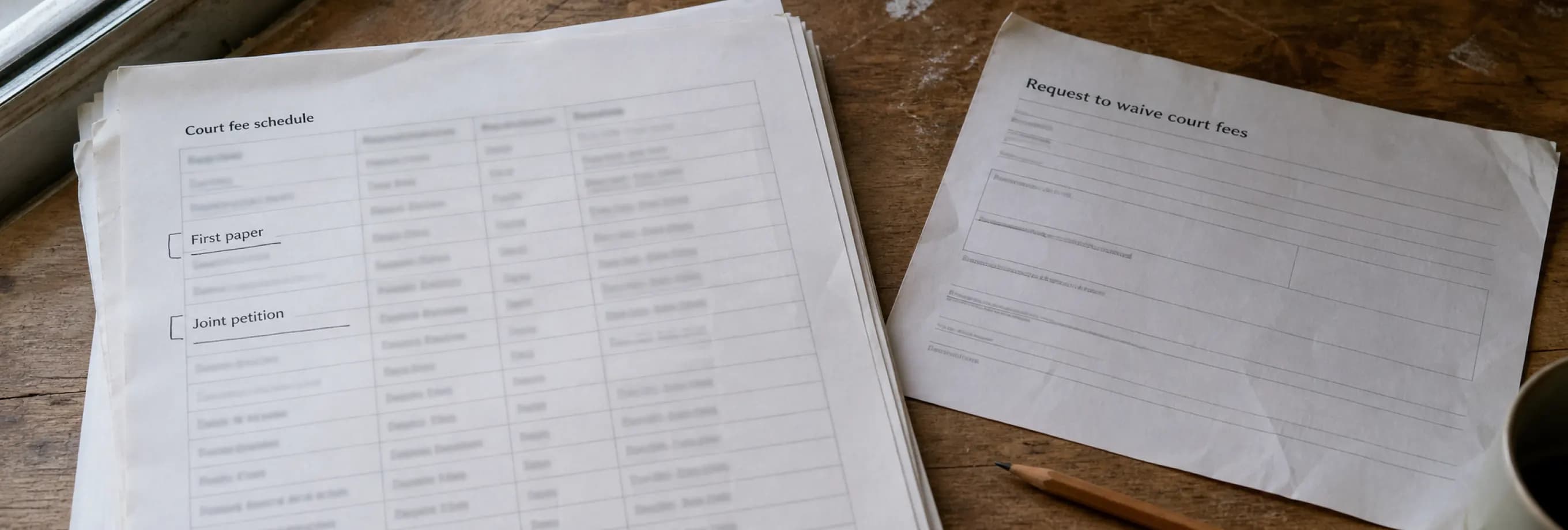
Filing the divorce forms costs $435–$450, according to the California Courts Self-Help Guide. The range is not vagueness: the statewide fee is the floor, and some counties add a local surcharge on top of it. The court where the case is filed publishes its own figure.
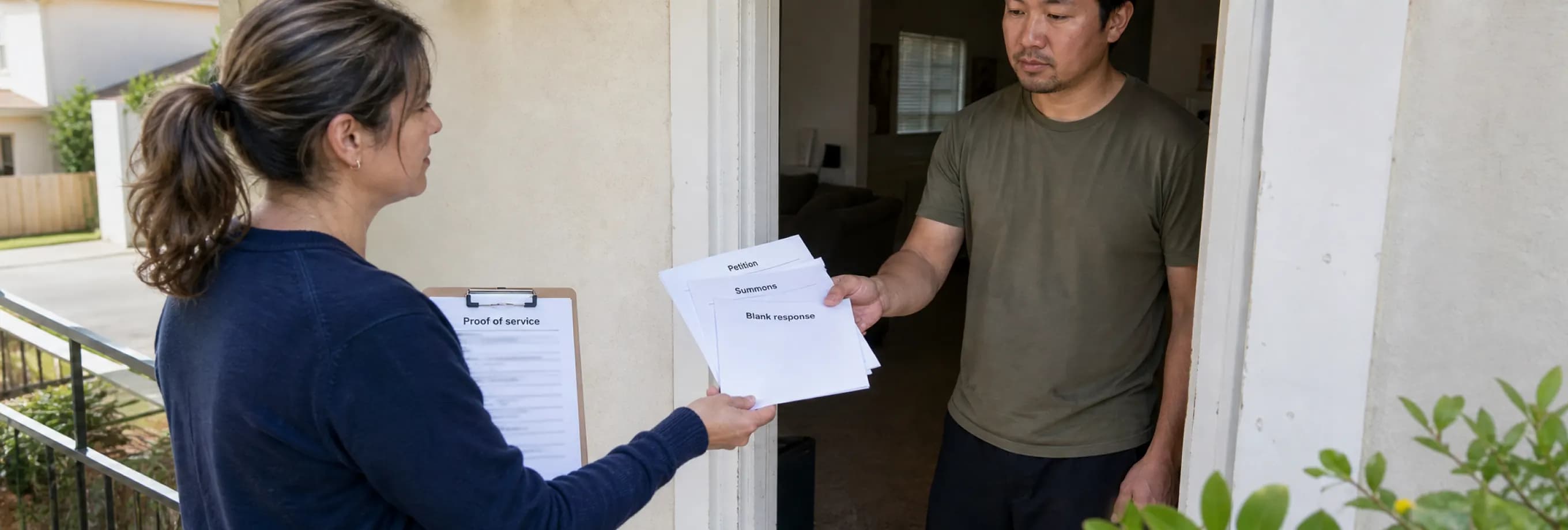
The spouse who files first pays it. The spouse who answers pays a filing fee of their own when they file a Response (form FL-120); a spouse who never files a response never pays one.
There is a second front door with its own price. Since January 1, 2026, spouses who agree can open the case together on a joint petition, and the fee schedule lists that at $870 — one item covering the appearance of both petitioners, before any local surcharge. It is not a discount: both appearances are paid at the outset instead of one now and one later. The exception is a joint petition for summary dissolution, listed separately at $435.
Filing fees are the whole of what the court requires: $435–$450 for a regular petition, $870 for a joint one, plus a response fee where there is a response. Everything past that is professional time, and professional time scales with disagreement — not with the length of the marriage.
Additional court costs appear only if the case needs them: a motion, a court reporter, a records request.
If the fee is out of reach
California has a formal way to not pay it. A Request to Waive Court Fees (form FW-001) asks the court to let the case proceed without the filing fee and some other court costs. It is granted on financial grounds: receiving public benefits, income below a published line, or not being able to pay the fee and still meet basic needs. It is not a judgment about the case. What the waiver covers, and what it does not, is set out in getting divorced when you have no money.
What makes up the rest of the bill
The usual drivers, roughly in order of how much they move the number:
- Custody and parenting time. Often the largest. A disputed parenting schedule can require evaluations, hearings, and repeated filings.
- Property that has to be valued before it can be divided. A house, a business, stock compensation, a pension. Valuation is often a separate professional, not the attorney.
- Support. Spousal support is argued more often than child support, which follows a statewide guideline calculation.
- How the other side behaves. Missed deadlines and incomplete financial disclosures cost the other party money, and nobody controls that from their side of the case.
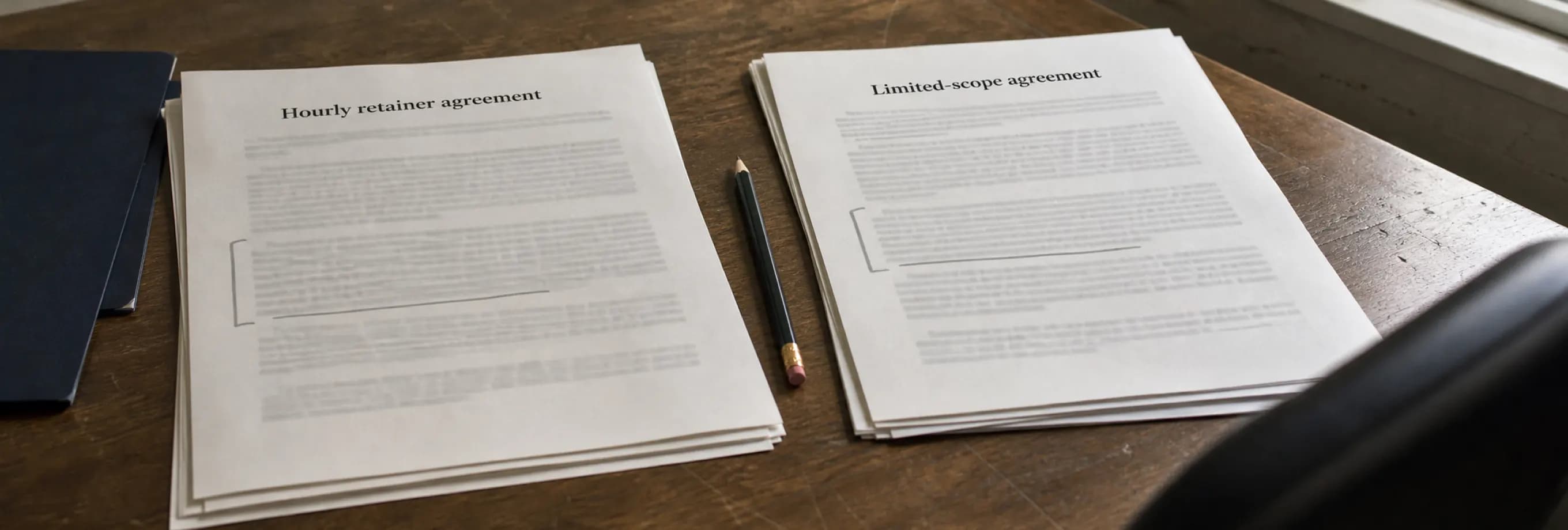
Attorneys in California work on an hourly rate against a retainer, on a flat fee for a defined and uncontested scope, or on limited-scope representation — hired for one hearing or one set of documents rather than the whole case. The billing arrangement is written into the fee agreement, and it is a reasonable thing to ask about in a first consultation.
The cheapest route, for the people it fits
California has a short-form divorce called summary dissolution, and it is genuinely simpler — but its conditions are narrow. Broadly, both spouses have to agree to use it, and the marriage has to be short (under five years), with no children together, and little property or debt between them. There is also a residency requirement: one spouse in California for the last six months and in the filing county for the last three.
It still costs the filing fee, and it still takes six months — here counted from the day the papers are filed, since nobody is served. Either spouse can end it during that period by filing a revocation under Family Code section 2402, and the judgment is entered at the six-month mark only if none was filed.
The full list of conditions is on the court's own page — it is a checklist, and missing one item disqualifies the case.
Time is part of the cost
A California divorce takes at least six months, counted from service on the responding spouse or from that spouse's appearance, whichever comes first. On a joint petition or a summary dissolution, where nobody is served, the clock runs from the filing date. That is a statutory minimum, not a queue — complete agreement does not shorten it.
For budgeting, this matters more than it looks. Six months is the floor for a case where nothing is contested. A contested case is measured against the court's calendar, and every continuance is another cycle of preparation that somebody bills for.
“…the court may base an award of attorney’s fees and costs on the extent to which any conduct of each party or attorney furthers or frustrates the policy of the law to promote settlement of litigation and, where possible, to reduce the cost of litigation by encouraging cooperation between the parties and attorneys.”
— Family Code section 271(a)
What actually reduces the bill
- Arrive with the financial disclosure already assembled. Both spouses must exchange complete financial disclosures. Time spent reconstructing statements at an hourly rate is the most avoidable line on any invoice.
- Separate the decisions you have already made from the ones you have not. Fees are spent on the second group.
- Ask what the fee agreement covers before signing. Hourly versus flat, what the retainer replenishes, who bills for paralegal time.
- Ask whether limited-scope representation fits. Not every case needs an attorney from filing to judgment.
- Know that mediation exists as a route to a settlement the court then approves, and that it is priced differently from litigation.
Before you compare quotes
A fee quote only means something against a defined scope. Two attorneys quoting different numbers for "a divorce" may be describing different amounts of work — one assuming an uncontested filing, the other assuming a custody dispute. Ask each of them what the number assumes, and what happens to it if that assumption breaks.
Filing fees are fixed and published; everything after that depends on how much has to be decided. This directory lists 3,726 California family-law attorneys across 157 cities, so the price of a first conversation can be compared rather than guessed.
Common questions
- What is the court filing fee for a divorce in California?
- The California Courts Self-Help Guide puts the fee to file divorce forms at $435–$450, and a joint petition at $870. The range exists because some counties add a local surcharge, so the exact figure comes from the court where the case is filed.
- Can the filing fee be waived?
- Yes. A request to waive court fees is form FW-001, and it covers filing fees and some other court costs. It is decided on income, public benefits, or inability to pay basic needs — not on the merits of the case.
- Does the other spouse pay a fee too?
- The spouse who files a Response (form FL-120) pays a filing fee of their own. A spouse who never files a response does not pay one. The same fee waiver is available to either of them.
- Is a cheaper divorce possible without an attorney?
- California publishes its divorce forms and step-by-step instructions, and people do file without an attorney. That removes professional fees but not the court fee, and not the six-month minimum before a judgment can take effect.
- How long does a California divorce take?
- At least six months. The California Courts Self-Help Guide states the minimum plainly; agreement between the spouses does not shorten it.
Sources
Checked on August 16, 2026. Where this page and a court’s own published material disagree, the court is authoritative.
- Family Code section 271 — fees and costs as a sanction for conduct that frustrates settlement (opens in a new tab)
- California Courts Self-Help — File your divorce forms (filing fee) (opens in a new tab)
- California Courts Self-Help — Ask for a fee waiver (opens in a new tab)
- California Courts Self-Help — The divorce process (six-month minimum) (opens in a new tab)
- California Courts Self-Help — Summary dissolution qualifications (opens in a new tab)
- California Courts Self-Help — Respond to divorce papers (opens in a new tab)
- Family Code section 2403 — summary dissolution judgment six months after filing (opens in a new tab)
- California Courts — Statewide Civil Fee Schedule effective January 1, 2026 (opens in a new tab)