
- Official title
- Request for Order
- Issued by
- Judicial Council of California
- Revision
- Rev. July 1, 2025
- Use
- Mandatory
- Official PDF
- FL-300 on www.courts.ca.gov
A family-law case is pending, but an order is needed before it ends—or an existing order no longer fits the requested result. FL-300 is the form a party uses to ask the court to make those orders or change existing ones. The court uses the first page to set the hearing date, time, and location.
The current FL-300 became effective July 1, 2025. It is a four-page mandatory Judicial Council form. Its footer reads “Form Adopted for Mandatory Use, FL-300 [Rev. July 1, 2025]” and cites Family Code sections 2045, 2107, and 6224; Government Code section 70612; and California Rules of Court, rule 5.92. Chinese Simplified, Korean, Spanish, and Vietnamese translations are available.
This page explains the statewide form and the instructions printed on it. It is general information, not legal advice about which orders to request, what facts to include, or how a court may rule.
What can a party request on FL-300?
The first page lists Child Custody, Visitation (Parenting Time), Child Support, Spousal or Partner Support, Property Control, Attorney's Fees and Costs, and Other (specify). Separate boxes identify a requested Change or Temporary Emergency Orders.
The detailed sections ask for the requested custody and parenting-time terms; child-support amounts; spousal or domestic-partner support; temporary use, possession, and control of property; payment of debts and liens while a property-control order is in effect; attorney fees and costs; and any other requested orders. Where a request would change a current custody, parenting-time, support, or property-control order, the form asks for the date and terms of that order.
Item 1, Restraining Order Information, asks whether a domestic violence restraining or protective order is in effect, who it is between, and which criminal, family, juvenile, or other court issued it. The note on page 1 separately addresses changing or ending an order granted on DV-130 or JV-255.
What does the court complete before the hearing?
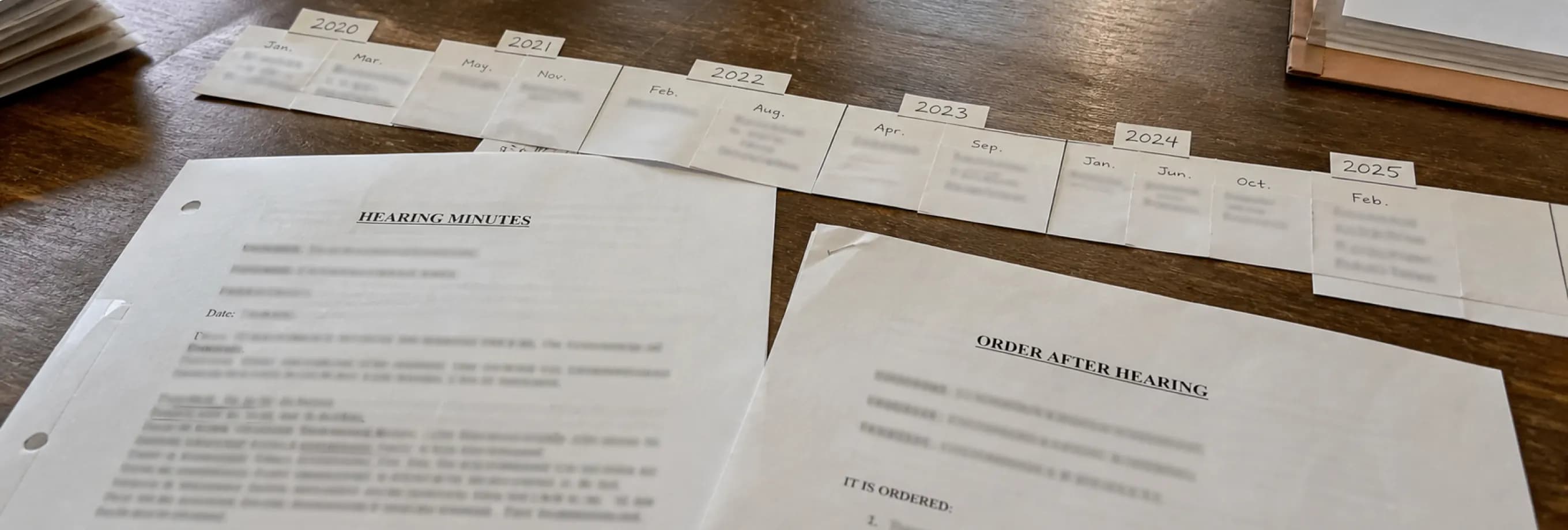
The clerk-completed Notice of Hearing on page 1 records who must receive notice and the hearing's date, time, department, room, and courthouse address. The court-order box can set a service deadline, set a deadline for an FL-320 Responsive Declaration, direct the parties to custody mediation or child custody recommending counseling, and state that temporary emergency orders on FL-305 apply.
FL-300 allows temporary emergency requests within the child-custody and property-control sections. When the court makes temporary emergency orders on FL-305, page 1 says that form must be personally served with all documents filed with the Request for Order.
What declarations and forms go with the request?
Item 9, Facts to Support, requires the facts supporting the requested orders to be written in the space provided or attached. The form permits an Attached Declaration for extra space and limits the supporting facts and attachments to 10 pages unless the court gives permission.
For child support, the form asks for a current Income and Expense Declaration or, when its stated requirements are met, a Financial Statement (Simplified), FL-155. The spousal or partner support section calls for a current Income and Expense Declaration and, for a postjudgment modification, a Spousal or Partner Support Declaration Attachment or a declaration covering the same factors. The fee section lists an Income and Expense Declaration, a Request for Attorney's Fees and Costs Attachment, and a Supporting Declaration for Attorney's Fees and Costs Attachment.
California Rules of Court, rule 5.92, requires a current FL-150 Income and Expense Declaration to be filed with FL-300 when the request involves support or attorney fees.
What does the form say about service?
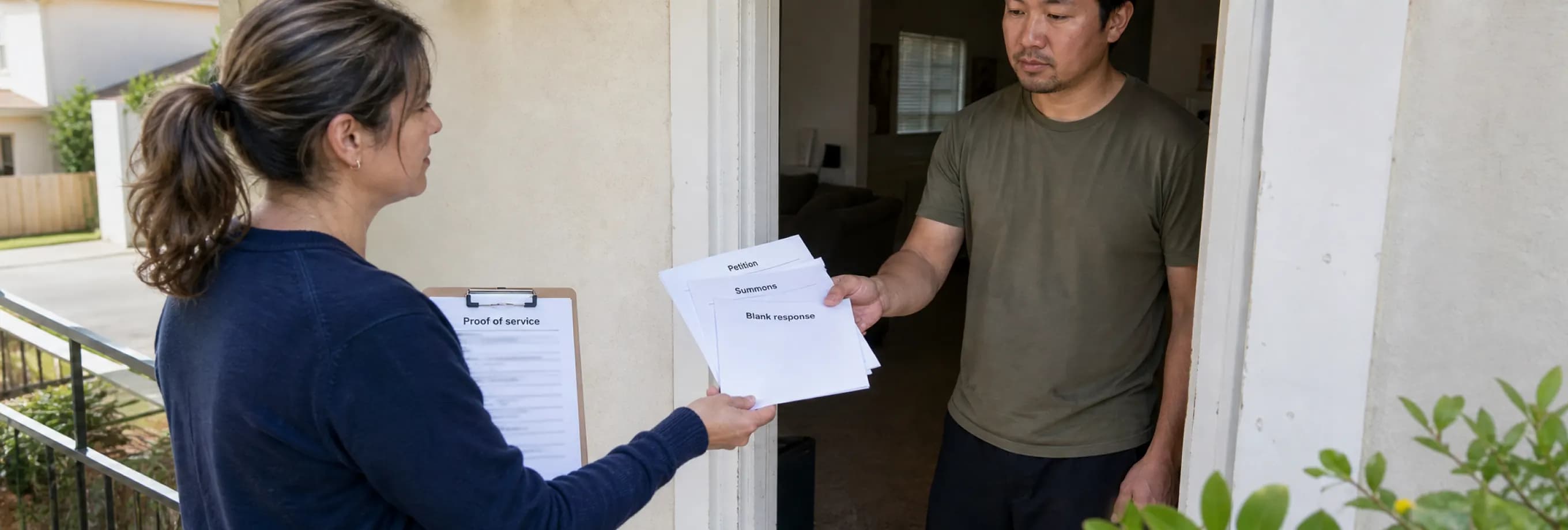
The warning to the person served says the court may make the requested orders without that person if the person does not file FL-320, serve it on the other parties at least nine court days before the hearing unless the court orders a shorter period, and appear at the hearing. It points to FL-320-INFO for more information.
The Request for Order does not print one fixed service period for every request. Item 8 provides space to request service no fewer than a stated number of court days before the hearing or to ask for an earlier hearing and service date, with reasons. The court-order section then provides the actual date by which service must occur.
For a reader preparing the request, a limited-scope consultation can focus on whether the selected orders, supporting facts, and attachments match what the form asks for. AttorneyIndex is a directory; readers may browse family law attorneys in Los Angeles without the directory selecting or recommending one.
Common questions
- What is California form FL-300?
- FL-300 is the Request for Order used to ask the court for orders while a family-law case is pending or to change existing orders. The court also uses it to set the hearing date, time, and location.
- What orders can FL-300 request?
- The form lists child custody, visitation or parenting time, child support, spousal or partner support, property control, attorney fees and costs, and other orders. It also provides boxes for a change and temporary emergency orders.
- Does a support request need form FL-150?
- Yes. California Rules of Court, rule 5.92, requires a current Income and Expense Declaration, form FL-150, with an FL-300 request involving support or attorney fees.
- How long may the supporting facts be?
- Item 9 says the facts written in support of the request and attached to it cannot exceed 10 pages unless the court gives permission.
- Is FL-300 available in other languages?
- California Courts provides Chinese Simplified, Korean, Spanish, and Vietnamese translations. The current English form became effective July 1, 2025.
Sources
Checked on September 22, 2026. Where this page and a court’s own published material disagree, the court is authoritative.
- Judicial Council of California — Form FL-300 (opens in a new tab)
- California Courts Self-Help — Form FL-300 information (opens in a new tab)
- California Rules of Court, rule 5.92 — Request for Order and supporting papers (opens in a new tab)
- Family Code section 2045 (opens in a new tab)
- Family Code section 2107 (opens in a new tab)
- Family Code section 6224 (opens in a new tab)
- Government Code section 70612 (opens in a new tab)