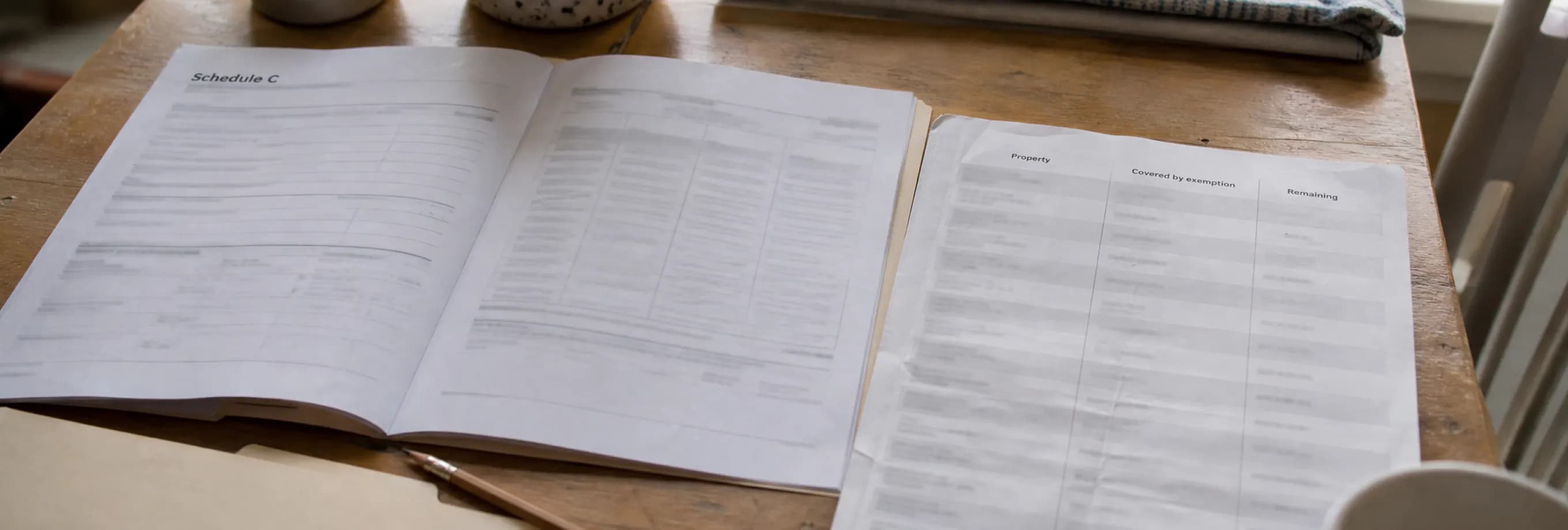

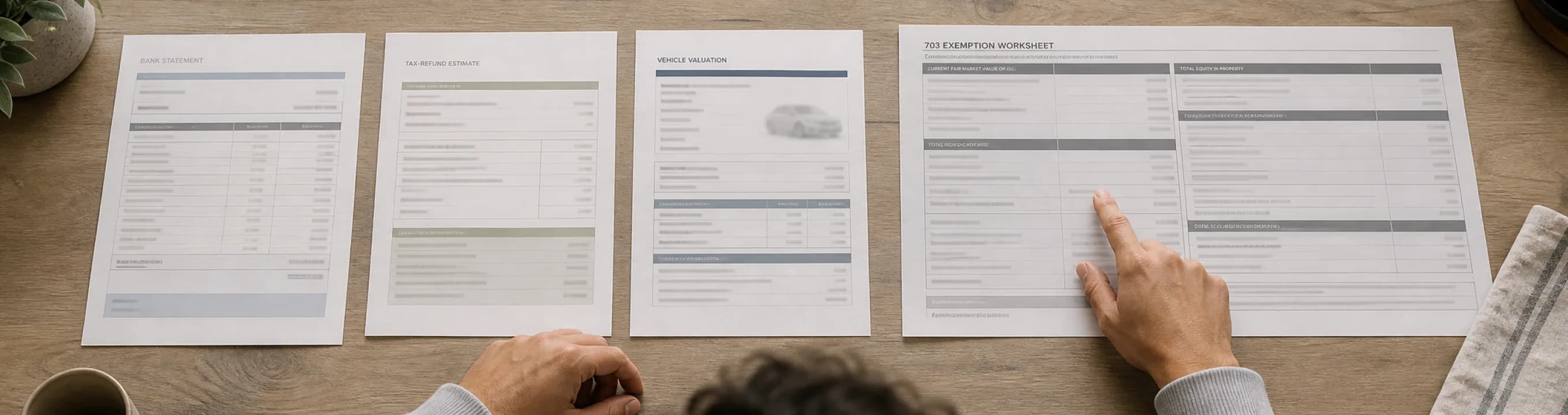
Schedule A/B is finished. One column shows a tax refund and money in the bank; another shows home equity; a paid-off car sits between them. Schedule C now asks which exemptions cover that property. In California, that means comparing two systems across the whole asset list.
The short distinction is useful but incomplete: the 703 system offers a flexible wildcard, while the 704 system offers the much larger principal-residence homestead. A renter may care more about the wildcard because it can reach liquid property or excess vehicle equity. A homeowner may care more about the 704 homestead. Neither label decides the election by itself, and the two systems cannot be mixed on one Schedule C.
This guide explains the statewide exemption framework. It does not select an exemption system or apply it to an individual filing.
The wildcard follows whatever the residence exemption does not use
Code of Civil Procedure section 703.140(b)(5) makes the 703 wildcard available for any property. That phrase is the reason a category designed as a catchall can cover a checking account or an expected tax refund. It can also supplement the separate vehicle exemption.
The Judicial Council's current notice, form EJ-156, supplies the adjusted numbers. These amounts apply to cases commenced from April 1, 2025 through March 31, 2028. Section 703.140 itself is not where to read them: the code text still carries its original, unadjusted figures, because the adjustments are published in the Judicial Council notice under section 703.150 rather than written back into the statute. Finding smaller numbers on the legislature's site is not finding an error.
| 703 amount | Dollar figure | Authority and effective period |
|---|---|---|
| Residence exemption | $36,750 | EJ-156; April 1, 2025–March 31, 2028 |
| Base wildcard | $1,950 | EJ-156; April 1, 2025–March 31, 2028 |
| Potential wildcard if the residence amount is entirely unused | $38,700 | CCP 703.140(b)(5) plus EJ-156; April 1, 2025–March 31, 2028 |
| Motor vehicles | $8,625 | EJ-156 under CCP 703.140(b)(2); April 1, 2025–March 31, 2028 |
| Tools of the trade | $10,950 | EJ-156 under CCP 703.140(b)(6); April 1, 2025–March 31, 2028 |
The last part of the residence amount can be moved into the wildcard only to the extent it remains unused. Applying some of it to a residence leaves less for the catchall. The wildcard is therefore an allocation, not a separate bonus added after every other exemption.
The arithmetic is worth doing once. Put $20,000 of the residence exemption against home equity and $16,750 of it is left; the wildcard is then $1,950 plus that remainder, or $18,700. Use none of the residence amount and the wildcard reaches its full $38,700.
Home equity changes the center of the comparison
The 704 system has no comparable general wildcard. Its defining feature is the homestead in Code of Civil Procedure section 704.730. For exemptions claimed during January 1 through December 31, 2026, that statute's inflation-adjusted floor is $370,650 and its ceiling is $741,300. The amount between those limits is tied to the prior calendar year's countywide median sale price for a single-family home — which is why two filers with identical equity can hold different exemptions on opposite sides of a county line. The linked 2026 California homestead guide explains that calculation.
That difference can move a homeowner's attention toward 704, but the house is not the only line on Schedule A/B. A homeowner may also have a refund, deposits, a vehicle, tools, or a claim. The 704 homestead can cover home equity while leaving another asset outside its specific category; the 703 wildcard can cover the other asset while offering far less residence protection.
The vehicle comparison is unusually simple for the current period. Judicial Council form EJ-156 lists $8,625 under 703.140(b)(2) and $8,625 under 704.010, both effective April 1, 2025 through March 31, 2028. The legal categories are not worded identically: 703 covers the debtor's interest in one or more vehicles, while 704 covers aggregate vehicle equity and specified sale or insurance proceeds. Equity generally means market value minus a valid vehicle loan.
Tools of the trade are where the two systems stop being symmetrical. EJ-156 lists $10,950 under 703.140(b)(6) for implements, professional books and tools of the trade, and $10,950 under section 704.060 for personal property used in the debtor's trade, business or profession. The difference is what 704 does next: where both spouses use the property in a common trade, the figure is $21,900. Commercial vehicles carry their own sub-caps inside that line — $4,850 for one spouse, $9,700 for the common-trade amount. The 703 side has no equivalent doubling, so a couple working the same business is one of the clearer cases for looking at 704 first.
Money sitting in a bank account is the other place the two systems diverge, and it is the newest. Under section 704.220, a deposit account carries an automatic exemption — protected without the debtor claiming it — of $2,325 per judgment debtor. That figure runs on its own clock: form EJ-156 states it is effective July 1, 2026, and that unless a statute says otherwise it is adjusted annually each July 1 by the Department of Social Services, rather than on the three-year April cycle that governs the other amounts. It does not crowd out the other deposit-account rules: where section 704.080 gives a larger automatic amount for directly deposited social security or public benefits — $4,400 for social security with one designated payee, $6,575 with two or more — that larger amount applies instead. The 703 set has no equivalent automatic floor for a bank balance, which is one more thing the wildcard is asked to carry.
“If spouses are joined in the petition, they jointly may elect to utilize the applicable exemption provisions of this chapter other than the provisions of subdivision (b), or to utilize the applicable exemptions set forth in subdivision (b), but not both.”
— Code of Civil Procedure section 703.140(a)(1)
One ledger exposes the tradeoff
Official Form 106C takes its property descriptions and values from Schedule A/B. It asks for the current value of the portion owned, the amount claimed exempt, and the specific law supporting the claim. That structure supplies a practical comparison without pretending that the largest headline number controls.
| Property from Schedule A/B | Current value or equity | 703 law and amount used | 704 law and amount used | Uncovered under each system |
|---|---|---|---|---|
| Principal residence | ||||
| Bank deposits | ||||
| Expected tax refund | ||||
| Motor vehicles | ||||
| Tools or business property | ||||
| Claims or settlement rights |
A tax refund belongs on the comparison even when it has not arrived. Schedule A/B calls for tax refunds owed to the filer, and Schedule C is where an applicable exemption is claimed. Under 703, the wildcard may cover some or all of that interest if sufficient capacity remains. Under 704, the analysis turns on the narrower exemptions that apply to the particular property; there is no general 704 catchall matching section 703.140(b)(5).

Marriage changes who makes the election
Section 703.140(a)(1) says that spouses joined in one bankruptcy petition jointly elect either the 703 exemptions or the other California exemptions. They cannot place one spouse under 703 and the other under 704. Code of Civil Procedure section 703.110 does not double an exemption merely because the property or case involves two spouses.
A married person filing without a spouse faces a different statutory path. Section 703.140(a)(2) generally requires written waiver by both spouses for the filing spouse to use 703. The statute has a living-separate-and-apart exception, with a further qualification when the spouses share an ownership interest in potential homestead property. Those facts affect access to the system before the asset-by-asset comparison begins.
An amended Schedule C is still one schedule
Code of Civil Procedure section 703.140 says the 703 exemptions may be elected in place of the other California exemptions, but not alongside them. Official Form 106C separately asks for the law supporting each claimed exemption and includes a checkbox for an amended filing. The first filed schedule is therefore not described by the official form as categorically irreversible.
The form does not answer every amendment question. Timing, notice, an objection already made, and the procedural posture of the case may matter. A defined legal review can be limited to reconciling Schedule A/B values, running both California systems, and checking the proposed Schedule C before it is filed or amended.
AttorneyIndex is a directory, not a matching or referral service. Its San Francisco bankruptcy directory lets readers browse attorney listings and make their own contact decisions. When the asset schedule contains both liquid property and home equity, the useful work product is the completed two-column ledger, not a reflexive choice based on renter or homeowner status.
The election is made once and shapes everything after it. Of the 1,523 bankruptcy attorneys in this directory, 66 hold State Bar certification in Bankruptcy Law — a small enough number that it is worth filtering for.
Common questions
- What is the difference between California's 703 and 704 exemptions?
- The 703 system is available in bankruptcy and includes a general wildcard built from a base amount plus any unused 703 residence exemption. The 704 system includes California's much larger homestead exemption but no comparable general wildcard. Code of Civil Procedure section 703.140 permits one system or the other, not a mixture.
- What is the wildcard exemption?
- Under Judicial Council form EJ-156, for cases commenced from April 1, 2025 through March 31, 2028, the 703 wildcard is $1,950 plus any unused portion of the $36,750 residence exemption. If none of the residence exemption is used, the potential wildcard is $38,700.
- Can I protect my tax refund in bankruptcy?
- A tax refund can be listed as property on Schedule A/B and claimed on Schedule C when an applicable exemption covers it. The 703 wildcard can apply to any property, but the available amount depends on how much of that wildcard has been allocated elsewhere.
- Can spouses choose different systems?
- Spouses filing a joint petition cannot split the election. Code of Civil Procedure section 703.140(a)(1) requires a joint choice of the 703 system or the other California exemptions. A married person filing alone faces separate waiver and living-apart rules under section 703.140(a)(2).
- Can I change systems after filing?
- Official Form 106C includes an amended-filing checkbox, so an exemption schedule is not presented as unchangeable. An amended Schedule C still claims one set of exemptions, and the form alone does not resolve any timing, notice, or objection issue raised in a particular case.
- How much of my car is protected?
- Judicial Council form EJ-156 lists $8,625 for one or more motor vehicles under 703.140(b)(2) and $8,625 in aggregate motor-vehicle equity and specified proceeds under 704.010. Both took effect April 1, 2025 and hold until the next three-year adjustment on April 1, 2028, but they reach a given case by different routes: Code of Civil Procedure section 703.150(f) ties the 703.140(b) amounts to the date the case was commenced, while the 704.010 amounts are governed by section 703.050 instead. A loan reduces equity, but it does not reduce the vehicle's market value.
Sources
Checked on August 16, 2026. Where this page and a court’s own published material disagree, the court is authoritative.
- California Courts form EJ-156 — exemption amounts effective April 1, 2025, until the next three-year adjustment (opens in a new tab)
- Code of Civil Procedure section 703.140 — alternative bankruptcy exemptions (opens in a new tab)
- Code of Civil Procedure section 703.150 — adjustment schedule (opens in a new tab)
- Code of Civil Procedure section 703.110 — married-couple exemption limits (opens in a new tab)
- Code of Civil Procedure section 704.010 — motor vehicle exemption (opens in a new tab)
- Code of Civil Procedure section 704.060 — property used in a trade or business (opens in a new tab)
- Code of Civil Procedure section 704.220 — automatic deposit-account exemption (opens in a new tab)
- Code of Civil Procedure section 704.730 — homestead exemption (opens in a new tab)
- U.S. Courts Official Form 106C — Schedule C (opens in a new tab)
- U.S. Courts Official Form 106A/B — Schedule A/B (opens in a new tab)
- U.S. Courts — Instructions for Individual Debtors (opens in a new tab)