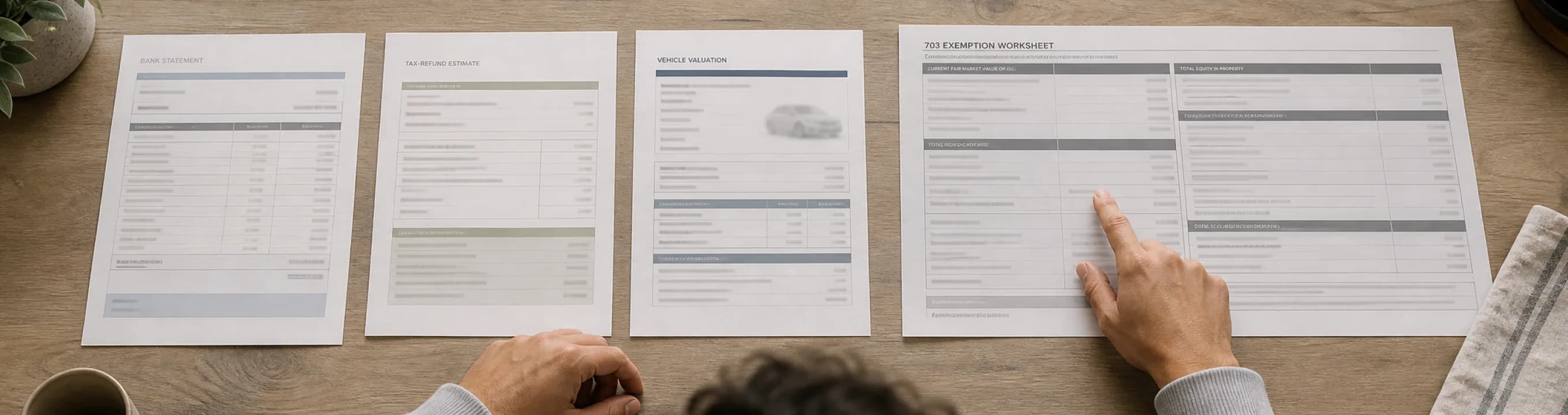


The mortgage statement says $410,000. An online estimate puts the home at $900,000. The owner then finds two California homestead numbers and tries to decide whether either one means the house is safe in Chapter 7.
Neither number answers that question by itself. For 2026, California's homestead exemption has a $370,650 floor and a $741,300 ceiling. The amount within that range depends on the prior year's countywide median sale price for a single-family home. It protects a dollar interest in a qualifying residence, not the property from every possible sale.
This guide provides general legal information about the 2026 calculation. It does not evaluate a home, determine eligibility for an exemption, or predict what a bankruptcy trustee will do.
Start with the county number, then ask where it came from
Code of Civil Procedure section 704.730 sits inside the 704 system, one of the two California filers must choose between. It makes the exemption the greater of two figures:
- the countywide median sale price for a single-family home in the calendar year before the exemption is claimed, limited by the inflation-adjusted ceiling; or
- the inflation-adjusted floor.
The statute began with $300,000 and $600,000 and requires an adjustment each January 1 by the change in the annual California Consumer Price Index for All Urban Consumers over the one-year period ending the preceding December 31, rounded to the nearest $25. The Department of Industrial Relations publishes that index. The statute supplies the formula; the final homestead figures are what the formula returns, and they are not printed in the index table.
Because published figures for 2026 differ from one another, here is the whole chain from the statute's own starting point, using the annual CCPI-U averages the Department publishes. Each year's result is the prior amount times the index change, rounded to $25, and the ceiling stays exactly twice the floor:
| Adjustment on January 1 | Index change applied | Floor | Ceiling |
|---|---|---|---|
| 2022 | 297.371 ÷ 285.315 | $312,675 | $625,350 |
| 2023 | 319.224 ÷ 297.371 | $335,650 | $671,300 |
| 2024 | 331.804 ÷ 319.224 | $348,875 | $697,750 |
| 2025 | 341.951 ÷ 331.804 | $359,550 | $719,100 |
| 2026 | 352.508 ÷ 341.951 | $370,650 | $741,300 |
Two checks are worth running on any figure offered for 2026. The unchained calculation should agree: $300,000 × 352.508 ÷ 285.315 is $370,651.39, which rounds to $370,650. And the ceiling must be exactly double the floor, since the statute adjusts both by the same factor. A published pair where the second number is not twice the first was not produced by this statute.
If a county's qualifying 2025 median were $520,000, the section 704.730 amount for a 2026 claim would be $520,000. A lower median would leave the exemption at $370,650; a median above the ceiling would leave it at $741,300.
There is a less tidy part. Section 704.730 does not name a publisher, dataset, or method for choosing among county median figures. A number copied from a county chart is incomplete unless the chart identifies its source, the 2025 calendar-year period, the geographic scope, and that what it measures is the median sale price of single-family homes rather than assessed value or some other category of housing. The statute settles the formula. It does not settle a disagreement between datasets.
Home equity and sale proceeds are different lines
Return to the $900,000 estimate and $410,000 mortgage balance. Before considering sale costs, the gross equity is $490,000. Costs of sale do not change that figure; they reduce the money a sale could produce. The distinction matters because a trustee weighing a liquidation generally works from what would be left after likely sale costs, not from gross equity.
The 7 percent below is an illustration, not a statutory rate. Real sale costs vary with the county, the sale method, the commission structure, and the trustee's own analysis.
| Hypothetical sale calculation | Amount |
|---|---|
| Estimated sale price | $900,000 |
| Less mortgage and other liens | − $410,000 |
| Gross equity before sale costs | $490,000 |
| Less estimated sale costs, assumed here at 7 percent purely to illustrate | − $63,000 |
| Estimated net proceeds before the exemption | $427,000 |
With a $520,000 homestead, this example produces no estimated proceeds above the exemption. With the $370,650 floor, it leaves $56,350 before trustee compensation and other administrative expenses. Those are arithmetic results from assumed inputs, not sale predictions.
An automated estimate is not an appraisal. A mortgage statement may not be a current payoff quote, and another lien may appear in the public record. Even the sale-cost line depends on the transaction being modeled. Changing one input can change whether a trustee sees value for unsecured creditors.
A homestead amount is one line in a liquidation analysis, not a guarantee that the home stays out of a Chapter 7 sale.
The United States Courts describes a Chapter 7 trustee's role as liquidating nonexempt assets and distributing the proceeds to creditors. For a home, the economic question is what would remain after secured liens, sale costs, the allowed exemption, and the expenses associated with administering a sale. When that remainder is not useful to the estate, a trustee may decide against a sale. The general materials do not promise a particular threshold or outcome.
In bankruptcy, the petition date controls the snapshot
California Code of Civil Procedure section 703.140(c) says that, in a bankruptcy case, the value of property claimed as exempt and the exemptions available under the chapter are determined on the petition date. It also says that if residence equity is no more than the allowed homestead on that date, appreciation in the debtor's interest while the case is pending is exempt.
That rule does not eliminate disputes about the starting figures. A trustee can examine value, liens, the claimed exemption, and whether the property qualified as the debtor's homestead. The debtor lists the exemption on Schedule C, while valuation evidence and residence facts may require support elsewhere in the case.

Recording a declaration does a different job
California's automatic homestead provisions apply to a qualifying principal dwelling in a forced sale whether or not a homestead declaration was recorded. Recording a declaration does not increase the dollar amount under section 704.730 and does not turn an ineligible property into a homestead.
The declared-homestead statutes address other consequences. Under section 704.960, qualifying proceeds from the voluntary sale of a declared homestead are exempt up to the homestead amount for six months after sale. Section 704.950 also governs how a judgment lien attaches when a declaration was recorded before the abstract of judgment. Those rules should not be compressed into the claim that recording a form makes a home unsellable; section 704.970 expressly preserves the right of levy and routes a forced sale through the automatic-homestead provisions.
A review can end with one auditable calculation
The useful file for the opening homeowner is short: a supportable petition-date value, current payoff figures for every lien, a stated sale-cost assumption, facts supporting homestead status, and a sourced 2025 county median. Put those inputs beside the 2026 floor and ceiling. The result can then be checked without treating a web table as a legal conclusion.
A limited-scope bankruptcy consultation can be confined to that record: review the valuation and liens, identify the supported exemption figure, and explain the Chapter 7 sale calculation in writing. AttorneyIndex is a directory, not a law firm or referral service. Its county pages provide direct attorney contact details and links to State Bar records. The directory does not determine whether a home qualifies or how a trustee will act.
Whether a house is at risk is a calculation, not a headline number. This directory lists 1,523 California attorneys who list bankruptcy among their practice areas, across 157 cities; 66 are State Bar certified specialists in Bankruptcy Law. Neither figure is an official count of every bankruptcy attorney in the state.
Common questions
- What is the California homestead exemption in 2026?
- The 2026 floor is $370,650 and the ceiling is $741,300. Between those limits, Code of Civil Procedure section 704.730 uses the prior calendar year's countywide median sale price for a single-family home.
- Does the exemption protect the value of the whole house?
- No. It protects a dollar amount of equity in a qualifying homestead. In Chapter 7, a trustee may investigate whether a sale would produce a meaningful distribution after liens, sale costs, the exemption, and the expenses of administering the sale.
- Is a recorded homestead declaration required?
- Generally, no declaration is required for California's automatic homestead protection in a forced sale. A declared homestead has separate effects, including six months of protection for qualifying proceeds from a voluntary sale, but it does not increase the section 704.730 amount.
- Which date controls the exemption in bankruptcy?
- California Code of Civil Procedure section 703.140(c) measures the claimed property's value and the state-law exemption as of the bankruptcy petition date. The same provision addresses post-petition appreciation when residence equity did not exceed the allowed homestead on that date.
Sources
Checked on August 16, 2026. Where this page and a court’s own published material disagree, the court is authoritative.
- Code of Civil Procedure section 704.730 — homestead amount (opens in a new tab)
- Code of Civil Procedure sections 704.710–704.850 — automatic homestead (opens in a new tab)
- Code of Civil Procedure sections 704.910–704.995 — declared homestead (opens in a new tab)
- Code of Civil Procedure section 703.140(c) — bankruptcy petition-date rule (opens in a new tab)
- California DIR — California Consumer Price Index (opens in a new tab)
- California DIR — California CPI 1955–2026 (opens in a new tab)
- United States Courts — Chapter 7 bankruptcy basics (opens in a new tab)