

The last paycheck is gone, but it has not yet left the means test. A California worker who loses a job in May and considers an August filing would still report income received from February through July on Official Form 122A-1. The form looks backward over six full calendar months; it does not substitute the worker's income on the day the case is filed.
The first comparison is annualized income against California's median for the household size. An amount above that median is not a Chapter 7 verdict. It sends the calculation to Official Form 122A-2, where permitted deductions determine whether a presumption of abuse arises. The test is one gate among several; the rest of the sequence is in how Chapter 7 works in California.
This article explains the federal forms and tables as of August 15, 2026. It is general information, not a means-test calculation or a conclusion about whether anyone qualifies for or should file bankruptcy.
The filing month chooses the income window and the tables
Section 101(10A) defines current monthly income as an average derived during the six-month period ending on the last day of the calendar month before the case begins, when the required income schedule is filed. Form 122A-1 translates that rule into six full calendar months. An August filing uses February 1 through July 31; a September filing uses March 1 through August 31.
Form 122A-1 asks for wages, salary, tips, bonuses, overtime, commissions, and several other kinds of income. The statute is deliberately wide: income from all sources, counted without regard to whether it is taxable. There is no exception for money that arrived only once, which is worth knowing after a job loss — a severance payment inside the window is inside the average, and leaving it off the form is a misstatement rather than a judgment call. The word regularly appears in section 101(10A) for a different purpose: it governs amounts paid by someone else for the household expenses of the filer or the filer's dependents, which are included when regular.
Benefits received under the Social Security Act are excluded, and the exclusion is written to the Act rather than to a program, so retirement, disability and SSI benefits fall under it alike. The statute also excludes certain payments to victims of war crimes or terrorism and specified disability or death compensation for members of the uniformed services.
For a married person filing without a spouse, the form's treatment depends in part on whether the spouses live together or are legally separated. When the nonfiling spouse's income is reported, Form 122A-2 line 3 provides an adjustment for the portion not regularly used for household expenses of the filer or the filer's dependents. The form requires the purpose and amount of each subtraction.
After monthly income is totaled, Form 122A-1 multiplies it by twelve and compares the result with the median family income for the state and household size. The form asks for the number of people in the household; the median table supplies figures, not a rule for resolving a disputed household classification. That count is not simply the number of tax dependents, and shared custody, an adult child at home or a supported relative are the arrangements where it gets argued about.
The current official table is titled Census Bureau Median Family Income By Family Size (Cases Filed On or After July 15, 2026):
| California household entry | Annual median family income |
|---|---|
| 1 earner | $79,253 |
| 2 people | $102,797 |
| 3 people | $116,541 |
| 4 people | $139,071 |
| Each person above 4 | add $11,100 |
Those figures apply to cases filed on or after July 15, 2026. They are not new to that date: the California medians have stood unchanged since April 1, 2026, and what the July revision moved was the expense standards. The U.S. Trustee Program does not give an end date on the table. Before using the figures, select the filing period on the program's main means-testing page; median data and expense standards are revised on separate schedules.
Above median is where the longer calculation begins
If annualized income is less than or equal to the applicable median, Form 122A-1 directs the filer to mark that no presumption of abuse arises from the form and not to complete Form 122A-2. That statement is narrower than saying someone qualifies for Chapter 7. Section 707(b)(3) separately requires the court to consider bad faith or the totality of the debtor's financial circumstances when the statutory presumption does not arise or has been rebutted.
If annualized income is above the median, Form 122A-1 directs the filer to complete Form 122A-2. The distance above the median does not supply the result, because the second form calculates adjusted income and then subtracts several categories of deductions.
Above median means continue the form. It does not mean automatic disqualification.
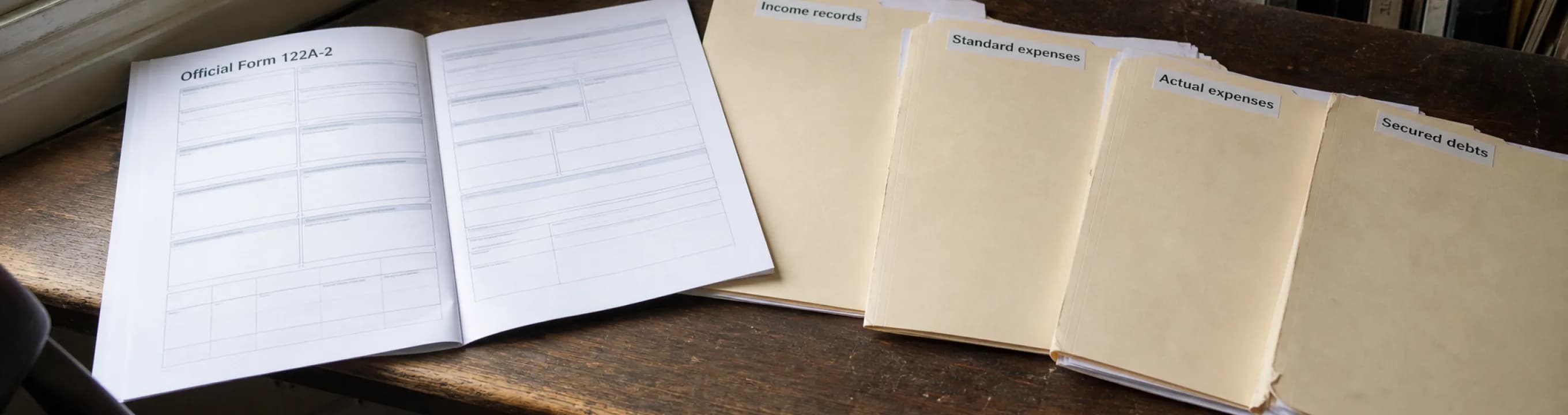
Form 122A-2 is more exact than a list of ordinary monthly spending. Its April 2025 edition separates the calculation into these parts:
- National Standards for food, clothing, other items, and out-of-pocket health care — one set of figures, the same everywhere;
- Local Standards for housing, utilities, and transportation — which vary by California county and metropolitan area, so two filers with identical budgets can deduct different amounts;
- specified actual expenses and additional deductions permitted by the form; and
- secured-debt, cure, priority-claim, and applicable Chapter 13 administrative-expense calculations.
For lines 6 through 15, the form instructs filers to use the standards identified on the form even when actual spending differs. Other lines call for actual amounts subject to their own definitions and limits. Mortgage and vehicle debt also appear in linked calculations so that the standard and the secured payment are not simply stacked as two unrelated deductions.
The applicable U.S. Trustee Program page is Census Bureau, IRS Data and Administrative Expenses Multipliers (Cases Filed On or After July 15, 2026). It links the National Standards, California county housing and utility standards, transportation standards, and administrative-expense multipliers in force for that filing period. A calculator can carry the correct median table and still use expense standards from the wrong period.
A presumption is a legal result, not the word “failed”
Form 122A-2 subtracts allowed deductions from adjusted current monthly income and applies the statutory comparison over sixty months. The dollar thresholds on the form are adjusted every three years — the last adjustment was April 1, 2025, and the form itself names April 1, 2028 as the next — so the operative form should supply them for the filing date rather than an undated article or calculator.
If the form shows no presumption, section 707(b)(3) still says the court shall consider bad faith and the totality of the debtor's financial circumstances in deciding whether granting Chapter 7 relief would be an abuse. If a presumption arises, section 707(b)(1) states that the court may dismiss the case or, with the debtor's consent, convert it to Chapter 11 or Chapter 13 when granting Chapter 7 relief would be an abuse.
Section 707(b)(2)(B) provides a route to rebut the presumption through special circumstances that justify additional expenses or an income adjustment for which there is no reasonable alternative. The section requires itemization, documentation, a detailed explanation, and an attestation under oath. Form 122A-2 Part 4 supplies the place to report those claimed circumstances. A recent job loss can change the six-month average as the window moves, but the statute does not make job loss an automatic adjustment or an automatic answer.
Where the job loss falls decides which mechanism is even in play. A loss inside the six-month window is already in the average, and cannot be counted a second time as a special circumstance. A loss after the window closed is the case section 707(b)(2)(B) exists for: the average still shows the old income, and the argument has to be made with itemization, documents and an oath.
A clean review packet keeps the legal question visible. It can contain six columns of income records, the completed draft of Form 122A-1, the exact U.S. Trustee Program tables for the assumed filing date, the draft Form 122A-2 if required, and records supporting every adjustment or actual expense entered.
Legal review can remain a defined assignment: check one assumed filing month, trace each disputed entry to the form or statute, and identify what additional record is missing. AttorneyIndex is a directory, not a matching or referral service. Readers can browse California bankruptcy attorneys by location, review individual listings and linked State Bar information, and contact an attorney directly; the directory does not select or recommend one. For the worker whose old wages still occupy the six-month window, that review answers a bounded question without turning a median-table comparison into a prediction about the case.
The means test is arithmetic; the judgment is which figures belong in it. This directory lists 1,523 California bankruptcy attorneys, 66 of them State Bar certified specialists in Bankruptcy Law.
Common questions
- What is the Chapter 7 means test?
- It is the income-and-deduction calculation used under 11 U.S.C. section 707(b) to determine whether a presumption of abuse arises in a Chapter 7 case involving an individual debtor with primarily consumer debts.
- What is the California median income for my household size?
- The U.S. Trustee Program table for cases filed on or after July 15, 2026 lists $79,253 for one earner, $102,797 for two people, $116,541 for three, and $139,071 for four, with $11,100 added for each person above four.
- Can someone file Chapter 7 with income over the California median?
- An above-median result on Form 122A-1 directs the filer to Form 122A-2. It does not by itself determine whether a presumption of abuse arises or whether Chapter 7 relief is available.
- What income counts in the Chapter 7 means test?
- Form 122A-1 averages income received from listed sources during the six full calendar months before filing. The Bankruptcy Code and form also identify regular household contributions and specific exclusions.
- What if someone just lost a job?
- The means test still uses the six full calendar months before the filing month. Older wages remain in that average until the filing window moves past the months in which they were received.
- What happens if the means test shows a presumption of abuse?
- A presumption is not an automatic dismissal. Section 707 states when the court may dismiss or, with the debtor's consent, convert the case, and it requires evidence, explanation, and an oath to establish claimed special circumstances that rebut the presumption.
Sources
Checked on August 16, 2026. Where this page and a court’s own published material disagree, the court is authoritative.
- U.S. Trustee Program — Means testing for cases filed on or after July 15, 2026 (opens in a new tab)
- U.S. Trustee Program — Census Bureau Median Family Income By Family Size (opens in a new tab)
- U.S. Courts — Official Form 122A-1, Chapter 7 Statement of Your Current Monthly Income (opens in a new tab)
- U.S. Courts — Official Form 122A-2, Chapter 7 Means Test Calculation (opens in a new tab)
- 11 U.S.C. section 101 — current monthly income definition (opens in a new tab)
- 11 U.S.C. section 707 — dismissal, conversion, and abuse analysis (opens in a new tab)