
Both spouses have FL-700 open on the table and are prepared to sign. Then one practical question interrupts the filing: what happens if child support cannot wait until the final agreement?
That question often decides which front door fits. California's joint petition lets two people open the same case without separate service or a response, but it does not provide a way to request temporary orders. It works for spouses who expect to reach a complete agreement and can manage the period before judgment without interim court orders.
This guide describes California's statewide procedure and does not give legal advice about an individual marriage. Court filing practices may vary by county.
The route is joint only at the front door
Since January 1, 2026, spouses and domestic partners may file Joint Petition—Marriage or Domestic Partnership (form FL-700) with Summons—Joint Petition (form FL-710). The papers identify them as Petitioner 1 and Petitioner 2. A case involving minor children also includes form FL-105.
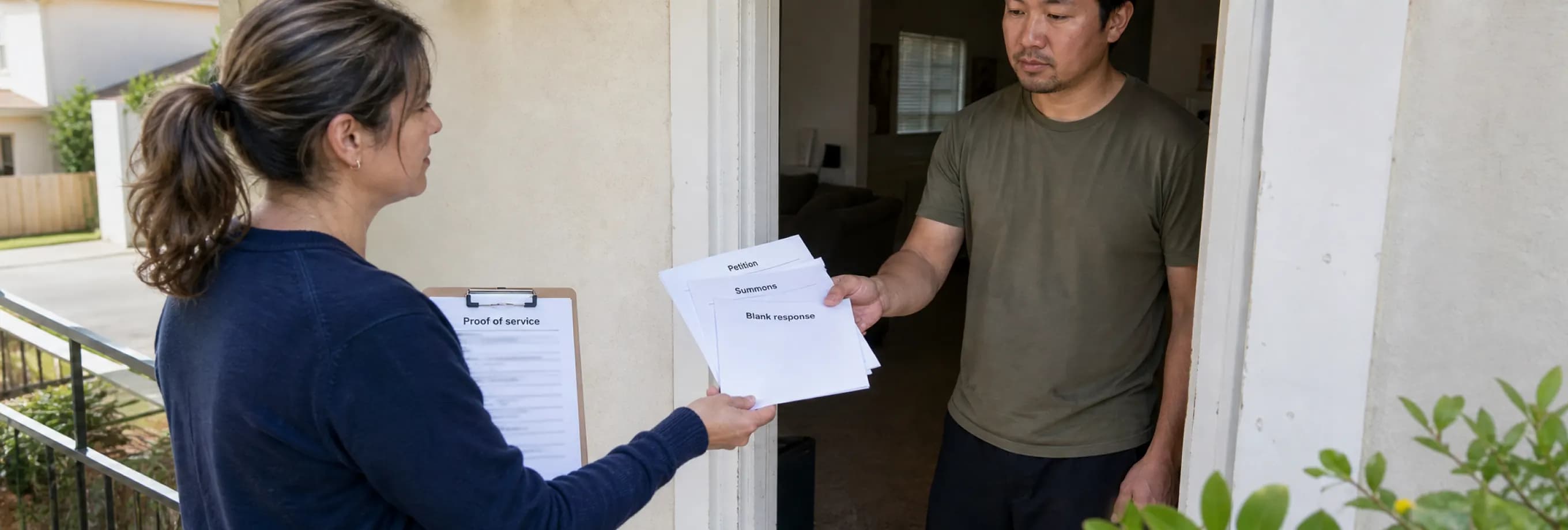
The joint filing gives the court authority over both petitioners without one serving papers on the other. Family Code section 2331(b) does both halves of that at once: on filing, the joint petition is deemed served on both parties and both are determined to have appeared in the matter — which is why neither spouse serves the other or files a response, and why the filing date starts California's minimum six-month period. In an ordinary case that clock starts with service, not filing.
The joint summons carries the automatic temporary restraining orders required by Family Code section 2040. Those are worth separating from the temporary orders discussed below: the restraining orders arrive with the papers and restrict both spouses without anyone asking, while a temporary order is something a party requests from the court.
After filing, the case still has the work that determines its outcome. The petition names the matters the parties intend to resolve by agreement; it is not the agreement. They complete the required financial disclosures, settle those listed issues in writing, prepare the judgment papers, and wait for judicial review.
What the filing fee does not buy
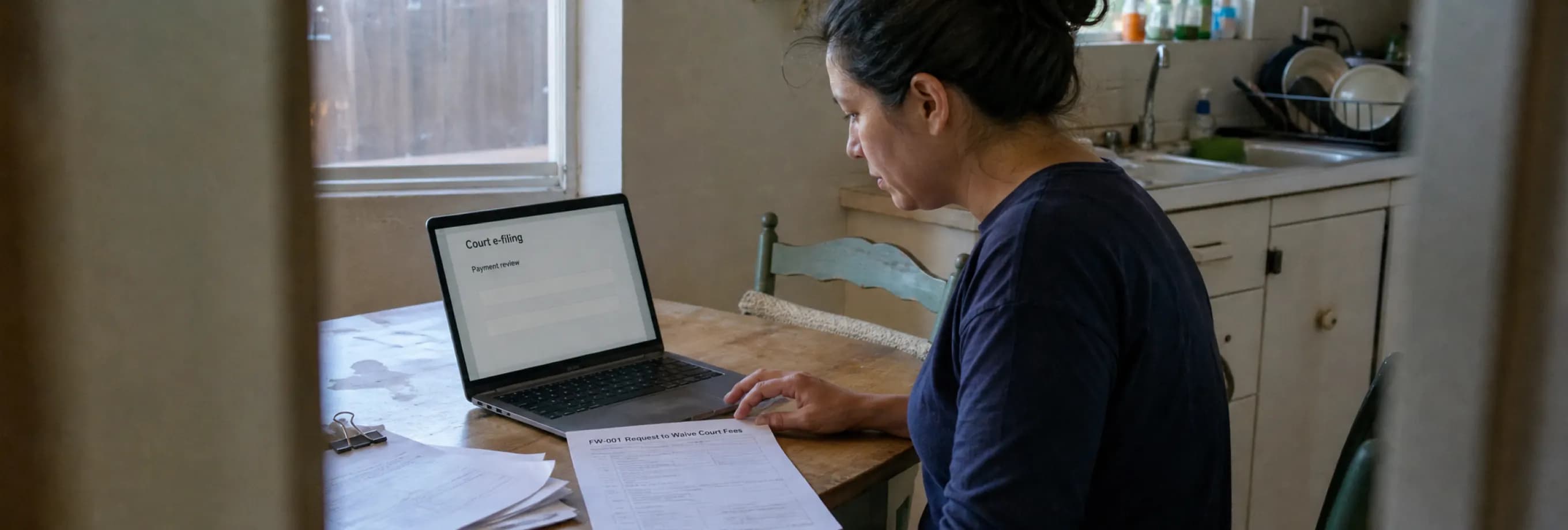
California Courts currently lists an $870 filing fee for the joint petition. The schedule marks the item with an asterisk, which means the amount varies in Riverside, San Bernardino and San Francisco, where a local courthouse-construction surcharge applies; the filing court publishes its own total. Each petitioner seeking a waiver submits a separate fee-waiver request. The joint route may avoid the mechanics and expense of service and a separate response, but it is not a discounted one-form divorce.
The statewide civil fee schedule carries that amount as its own item, and says of it that the fee covers the appearance of both petitioners. The statute behind it explains why: Family Code section 2342.5(h) requires a joint filing to be accompanied by the fees in Government Code section 70670, subdivisions (b) and (d) — the fee for the petition and the fee for the other party's first appearance — plus the supplemental fees, unless both petitioners hold waivers. Both initial appearances are paid at the outset, which is why the figure sits so far above the ordinary first-paper fee.
Two things follow from that, and the schedule states both. Even if a party later revokes the joint petition, no further first-appearance fee is owed by either person. And the $870 item expressly excepts summary dissolution: a joint petition for summary dissolution is a separate item at $435, the same as an ordinary first paper. So the joint route is not a discount — except in the one case where the schedule says it is.
| Joint petition | Regular petition |
|---|---|
| Both people sign the opening papers | One person files and serves the other |
| $870 listed filing fee | Filing and response fees arise separately |
| Deemed served on filing, which starts the six-month period | Service or the responding party's appearance starts it |
| No procedure for requesting temporary orders | Temporary orders may be requested from the court |
| Designed to end in a complete agreement, which need not exist at filing | The case may end by agreement, default, or trial |
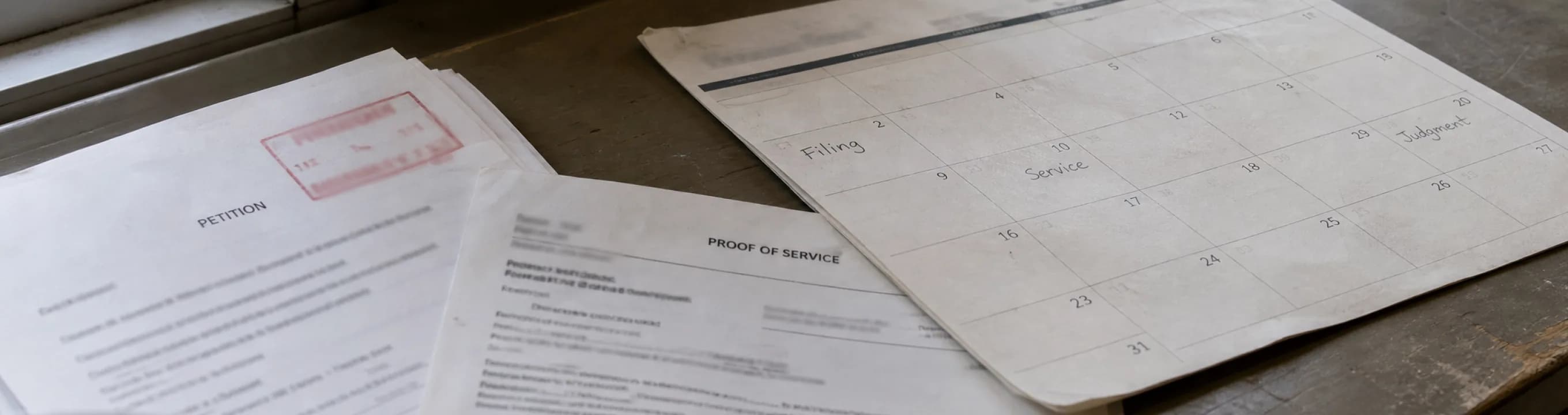
Nor does day one of the six-month period create an automatic end date. A joint petition filed on February 3 may establish the earliest date marital status can end, but the court still needs the required disclosures, final papers, agreement, and signed judgment. An incomplete file can remain open after the minimum period has passed.
Temporary orders are the screening question
California Courts states that temporary orders are unavailable in a joint-petition case. That limit reaches ordinary problems as well as emergencies. Two cooperative spouses may still lack a workable answer for support while one income funds separate homes, for a parenting schedule that starts next week, or for who may use an account while disclosures are being exchanged.
Cooperation can carry a case toward settlement. It cannot create an enforceable temporary order on a track that does not offer one.
A promise in a text or shared spreadsheet may be followed voluntarily. The regular process, however, has a procedure for asking the court to set temporary terms. The distinction matters before filing because months can pass between the opening papers and a complete judgment package.
Either petitioner may later leave the joint track. California Courts sets out the sequence: file Notice of Revocation of Joint Petition (form FL-720), then the amended pleading — Petitioner 1 an amended FL-100, Petitioner 2 an FL-120 as respondent — and serve it under the ordinary rules. Family Code section 2342.5(b) is what makes the amended pleading operative: filing it before judgment revokes the joint petition, and the case continues as a regular proceeding. Temporary orders can be requested at that point.
The earlier filing is not erased. Section 2342.5(b)(3) keeps the joint petition's filing date as the filing date of the action and for all relevant deadlines, naming the six-month period among them. What changing tracks does not do is supply orders for the months the case spent on the joint route.
An unfinished agreement can still fit
The petitioners do not have to arrive with every sentence of the settlement drafted. They can file, exchange disclosures, and finish negotiating afterward. The premise is narrower: both expect a complete agreement to be possible before they ask for judgment.
That leaves room for drafting and calculation. It leaves less room for a dispute that requires formal discovery or a court decision. An unvalued pension or missing business records can prevent a complete joint judgment even when most of the case is settled.
Independent review also remains available. Signing the same opening papers does not merge the spouses' interests or require them to use the same professional. One person may want a narrow review of the proposed property or parenting terms before signing the final agreement.
Give the filing decision a defined finish line
Before filing, the useful record is short and concrete:
- a draft FL-700 and the accompanying forms;
- a list of the issues still open;
- the financial records already available;
- any payment, parenting, property-control, or safety question that may arise before judgment.
A limited-scope consultation can stop at a specific deliverable: review those materials and identify whether the joint filing, the regular process, or more information is the appropriate procedural route. That is document review, not a commitment to full representation. If separate interests are involved, each spouse can arrange an independent review.
AttorneyIndex is a directory, not a referral service. Its county pages list California family law attorneys, link to State Bar information, show certified-specialist status where available, and allow direct contact. When both signatures are ready but the unanswered question concerns the months before judgment, that one-hour route-and-forms review has a clear endpoint: decide which first filing can do the job the spouses actually need it to do.
A joint petition still needs two people prepared to resolve every issue by agreement before judgment. Of the 3,726 family-law attorneys in this directory, 635 hold State Bar certification in Family Law. A review before signing is aimed at one question: whether the joint route can carry this case to judgment.
Common questions
- Can both spouses file for divorce together in California?
- Yes. Since January 1, 2026, spouses or domestic partners can use forms FL-700 and FL-710 to start a dissolution or a legal separation together, signing as Petitioner 1 and Petitioner 2.
- Do we have to agree on everything before filing jointly?
- No. The joint petition lists the issues the parties intend to settle; it is not the settlement. Both must expect to reach a full agreement before judgment, and if that stops being realistic, either person can revoke the joint petition and the case continues through the regular process.
- How much does a California joint divorce petition cost?
- California Courts currently lists an $870 filing fee, and the schedule marks it with an asterisk, so a local surcharge can change the total. Family Code section 2342.5(h) requires a joint filing to carry both the petition fee and the other party's first-appearance fee under Government Code section 70670, so the single figure covers both petitioners' initial appearances. A joint petition for summary dissolution is a separate item at $435. Each petitioner who needs a waiver files a separate fee-waiver request.
- Does a joint petition avoid the six-month wait?
- No. The six-month period runs from the filing of the joint petition, since the petition is deemed served that day. The divorce is not final until the court enters a judgment after all required steps are complete, which can be later.
- Can we request temporary orders in a joint-petition case?
- No. California Courts says temporary orders are not available while the case stays on the joint track; the regular process is where custody, support or property-control orders can be requested. Two things are separate from this: the automatic restraining orders that come printed on the summons, which bind both spouses without anyone asking, and emergency protective orders, which have their own procedure.
Sources
Checked on August 16, 2026. Where this page and a court’s own published material disagree, the court is authoritative.
- California Courts — Joint petition for divorce or legal separation (opens in a new tab)
- California Courts — Divorce in California (opens in a new tab)
- SB 1427 — Marriage joint petition for dissolution (opens in a new tab)
- Family Code section 2339 — minimum waiting period (opens in a new tab)
- Family Code section 2331 — joint petition deemed served on filing (opens in a new tab)
- Family Code section 2342.5 — joint petition procedure, revocation, and filing fees (opens in a new tab)
- California Courts — 2026 Statewide Civil Fee Schedule (opens in a new tab)