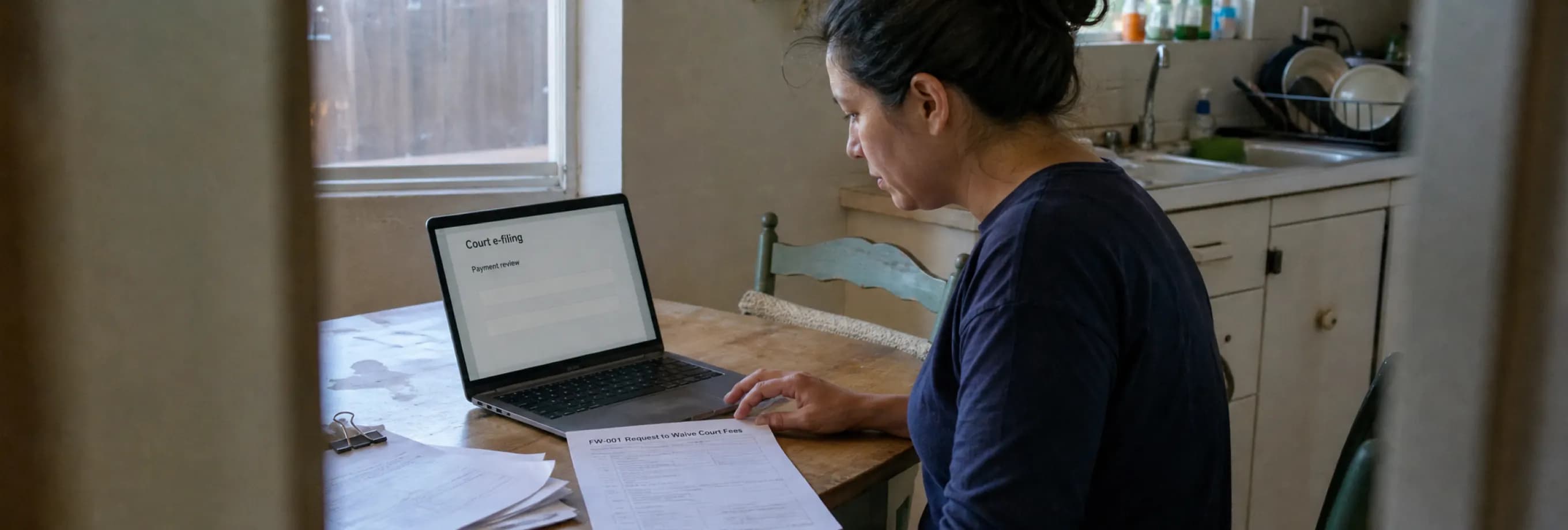

The declaration is open on one side of the screen and an AI-generated rewrite is on the other. The rewrite is clearer. It also changes “around March” to “March 3” and converts an accusation into a statement of fact. Then it supplies a legal citation that looks complete. The cursor is waiting over the filing button.
That is the line this guide addresses. A general-purpose chatbot can help arrange material that a person already has. It cannot decide which facts matter legally, confirm that an allegation has evidentiary support, or take responsibility for a signed court paper. Its fluency is useful during preparation and dangerous when treated as verification.
This page provides general legal information, not advice about a particular divorce or filing. Product terms, retention practices, and privacy controls change; they must be checked with the provider before sensitive information is entered.
Give the chatbot a bounded editing job
The lower-risk tasks have two features: the source material comes from the user, and the output can be checked against that material without making a legal judgment. A chatbot can put supplied dates in order, convert notes into a list of questions, identify inconsistent spellings of a name, or make a draft logistical message easier to read.
Keep a boundary between editing and deciding. “Arrange these dated entries without adding facts” is an editing instruction. Asking which parent should receive custody, whether an asset is separate property, what a judge will believe, or which facts should be omitted asks the tool to make a legal or strategic decision without the full record.
The same boundary applies to forms. A chatbot may help locate blank fields or restate an instruction in plainer language. The current Judicial Council form, its instructions, the local court's requirements, and the underlying records remain the materials to check. For the process around those forms, start with how divorce works in California, then return to the official court materials for the step being completed.
A polished citation is still only an assertion
General-purpose models can generate nonexistent authorities, misstate real ones, or omit the part of a rule that changes the answer. Asking the same model to check its first answer is another generation, not independent confirmation.
California's State Bar gives lawyers the same basic warning in professional terms. Its 2026 generative AI guidance, which replaces the November 2023 version, says these systems are known to produce outputs that may be false, misleading, fabricated, incomplete, or biased, and that a lawyer must exercise independent professional judgment by reviewing, verifying, and correcting them. Check you are reading the current one: the 2023 text is still in circulation and reads differently. The guidance governs lawyers' professional duties; it does not turn a chatbot into a legal source for someone handling a case without counsel.
A workable verification trail starts with the exact proposition in the draft. Open the cited statute, rule, Judicial Council form, or official court page. Confirm that the cited language exists, that it addresses the proposition, and that it is current. If the official source does not answer the question, the draft should not claim that it does.
Privacy controls do not create privilege
California Evidence Code sections 950 through 954 define privilege around confidential communications in a lawyer-client relationship. A direct exchange with a consumer chatbot does not create that relationship. A privacy setting or paid account does not change the legal definition.
There is a separate issue when a prompt contains advice or an email that was already exchanged with a lawyer. Evidence Code section 912 says voluntary disclosure of a significant part of a privileged communication can waive the privilege, subject to stated exceptions, including some disclosures reasonably necessary to accomplish the purpose for which the lawyer was consulted. Those statutes do not supply one answer for every AI product, account configuration, or reason for disclosure. Uploading an existing lawyer communication to a consumer chatbot may be treated as exactly that: a voluntary disclosure of a significant part of a privileged communication, which can waive the privilege unless an exception applies. The upload creates a dispute that did not exist while the communication stayed between lawyer and client.
The practical limit is data minimization. A task that can be completed with “Parent A,” month-only dates, and rounded figures does not require a child's name, home address, medical record, tax return, or full account number. For analysis that depends on unredacted facts or confidential legal advice, a consumer chatbot is the wrong workspace.
“…any party may obtain discovery regarding any matter, not privileged, that is relevant to the subject matter involved in the pending action … if the matter either is itself admissible in evidence or appears reasonably calculated to lead to the discovery of admissible evidence.”
— Code of Civil Procedure section 2017.010
Prompt history may become part of the evidence problem
California Code of Civil Procedure section 2017.010 permits discovery of relevant matter that is not privileged, including electronically stored information. It does not say that every chatbot conversation in a divorce is discoverable. Relevance, the wording and scope of a request, privilege, other objections, and any court limits still matter.
It does mean that “it was only a prompt” is not a categorical shield. A prompt asking the model to rewrite a disputed event, a generated chronology used to prepare testimony, or versions showing how a factual statement changed may draw attention if the material is relevant and not privileged. The statute settles the general scope of discovery; it does not settle whether a particular prompt must be produced in a particular case.
The filing rules attach to the person, not the tool
Code of Civil Procedure section 128.7 covers every pleading, petition, written notice of motion, or other similar paper presented to a California court. An attorney or unrepresented party presenting one of those papers certifies, after an inquiry reasonable under the circumstances, that legal contentions are warranted and factual contentions have or are likely to have evidentiary support. The statute also authorizes sanctions for violations, subject to its procedures and limits. By its own terms it does not reach the discovery set — disclosures and discovery requests, responses, objections and motions — which carries its own rules. So the certification is not the only duty in play, and it is not a license to be careless with discovery either.
Declarations carry a different but equally concrete act of ownership. Judicial Council form MC-030 ends with the declarant stating under penalty of perjury that the declaration is true and correct. The chatbot does not make that declaration. The signer does.
California's statewide AI provisions do not transfer that responsibility. Rule 10.430 and standard 10.80 took effect September 1, 2025. The rule requires courts that allow specified generative AI use by court staff or judicial officers to adopt use policies; the standard addresses judicial officers using generative AI in their adjudicative role. As of this review their text does not create a statewide AI-disclosure requirement for a self-represented litigant, and it does not approve an AI-assisted filing. Individual courts can and do adopt their own standing orders, so check the one where the case sits. Existing filing, evidence, and procedural rules continue to do their own work.
Before the declaration from the opening moves toward filing, compare it with the original records line by line. Separate supplied facts from generated language. Remove any authority that has not been verified in an official source. Identify each sentence that asks the court to draw a conclusion rather than report an event.
A reader can also choose a narrow professional assignment: review this proposed filing for its legal contentions, factual support, requested relief, and county procedure. That is a defined use of counsel, not a request for a lawyer to “fix the AI.” AttorneyIndex is a directory, not a matching or referral service. Readers browse California family law attorneys by location and contact an attorney directly; the directory does not select or recommend one.
The filing button should be the end of a verification process. A cleaner paragraph is not evidence that the process happened.
A chatbot has no license to lose. It cannot be sanctioned, suspended or held in contempt; the person who signs and files the paper can. The 5,012 attorneys in this directory have a license at stake: each listing is keyed to a State Bar number and links to the registry record it was built from, and 716 of them hold a State Bar Board of Legal Specialization certification.
Common questions
- Can I use ChatGPT to help prepare California divorce forms?
- A general-purpose chatbot can help organize facts or improve the wording of a draft. It does not verify that a form, legal claim, requested order, or local procedure is correct. The person who presents or signs a court paper remains responsible for it.
- Is a conversation with an AI chatbot protected by attorney-client privilege?
- A direct conversation with a consumer chatbot does not create a lawyer-client relationship or privilege. Uploading an existing confidential communication with a lawyer may create a waiver dispute under California Evidence Code section 912; the result can depend on the disclosure and its purpose.
- Can AI prompts or drafts be requested in discovery?
- Potentially. California discovery can reach relevant, nonprivileged electronically stored information. That does not make every prompt discoverable, but calling material a draft does not automatically protect it.
- Do California's statewide court AI rules govern people filing their own cases?
- Rule 10.430 governs court policies for staff and judicial officers, while standard 10.80 addresses judicial officers' adjudicative work. Neither is a statewide litigant disclosure rule or an approval of AI-assisted filings.
- What is a general-purpose chatbot useful for during divorce?
- It can sort dates supplied by the user, turn notes into a question list, simplify a draft message, or flag blanks for later checking. Original records and current official sources still control the legal work.
Sources
Checked on August 16, 2026. Where this page and a court’s own published material disagree, the court is authoritative.
- Code of Civil Procedure section 2017.010 — scope of civil discovery (opens in a new tab)
- California Rules of Court, rule 10.430 — court generative AI use policies (opens in a new tab)
- California Standards of Judicial Administration, standard 10.80 — judicial use of generative AI (opens in a new tab)
- State Bar of California — 2026 Practical Guidance for the Use of Generative AI (opens in a new tab)
- California Evidence Code sections 950–962 — lawyer-client privilege (opens in a new tab)
- California Evidence Code section 912 — waiver of privilege (opens in a new tab)
- California Code of Civil Procedure section 128.7 — representations to the court (opens in a new tab)
- California Code of Civil Procedure section 2017.010 — scope of discovery (opens in a new tab)
- Judicial Council of California form MC-030 — Declaration (opens in a new tab)